

[UPDATED 2025] Read JN0-223 Study Guide Cover to Cover as Literally
100% Real & Accurate JN0-223 Questions and Answers with Free and Fast Updates
NEW QUESTION # 34
Which data construct is used to guarantee that element names and data values remain unique in an XML document?
- A. element
- B. dictionary
- C. namespace
- D. schema definition
Answer: C
Explanation:
In XML documents, a namespace is the data construct used to ensure that element names and data values remain unique. Namespaces prevent naming conflicts by differentiating between elements or attributes that may have the same name but different meanings. This is particularly important in XML, where documents often incorporate elements from multiple sources.
Detailed Explanation:
XML Namespaces: A namespace is a collection of names, identified by a URI reference, which is used to distinguish between elements that may have identical names but different definitions or origins. This helps avoid ambiguity in the document.
How Namespaces Work: When a namespace is applied, each element or attribute in the XML document is associated with a prefix. This prefix, combined with the namespace URI, ensures that the element or attribute is uniquely identified, even if another element or attribute in the same document has the same local name but a different namespace.
Schema Definition vs. Namespace: Although an XML schema definition (XSD) can define the structure and type constraints of an XML document, it does not guarantee uniqueness of element names across different XML documents. That role is fulfilled by namespaces.
Practical Example:
xml
Copy code
<root xmlns:ns1="http://www.example.com/ns1"
xmlns:ns2="http://www.example.com/ns2">
<ns1:item>Item in namespace 1</ns1:item>
<ns2:item>Item in namespace 2</ns2:item>
</root>
In this example, the item elements are in different namespaces (ns1 and ns2), which keeps them unique even though they have the same name.
Reference:
Juniper Automation and DevOps Documentation: These practices highlight the importance of namespaces in XML documents to maintain the integrity and uniqueness of data, which is essential in automation scripts and configuration files.
W3C XML Namespace Specification: The World Wide Web Consortium (W3C) standard for XML Namespaces defines how namespaces should be used to avoid name conflicts.
Namespaces are a crucial concept in XML, ensuring that data can be consistently managed and interpreted correctly, particularly in complex systems where multiple XML documents or schemas are involved.
NEW QUESTION # 35
Which set of DevOps CAUMS values is correct?
- A. Continuous, Assimilation, Learn, Morning, and Scientific
- B. Culture Automation, Lean, Measurement, and Sharing
- C. Coordinate, Acculturation. Lean, Mentoring, and Society
- D. Control, Automation, Learn, Methodology, and Support
Answer: D
NEW QUESTION # 36
Exhibit.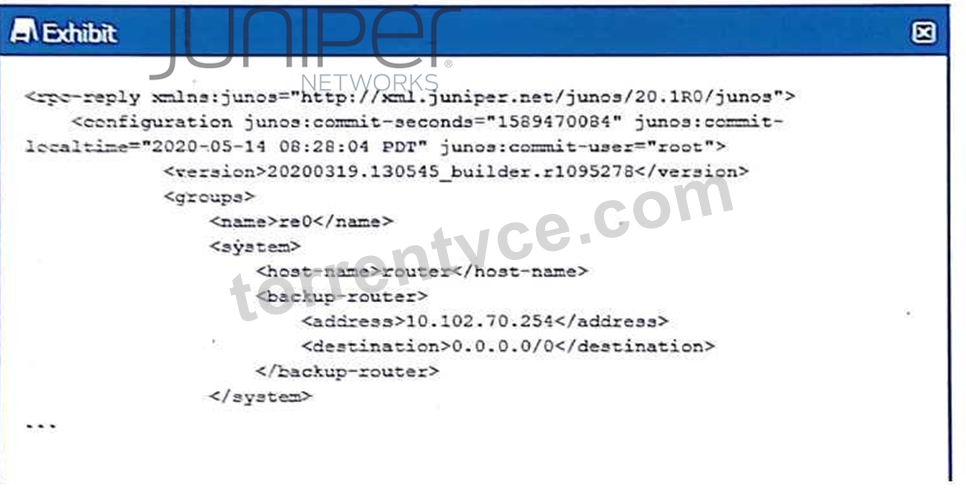
Referring to the exhibit, which XPath statement would retrieve the commit-user attribute in the candidate configuration?
- A. configuration/@ junos: commit-user
- B. configuration/junos: commit-user
- C. configuration/commit-user
- D. configuration:@ junos: commit-user
Answer: D
Explanation:
.
NEW QUESTION # 37
Exhibit.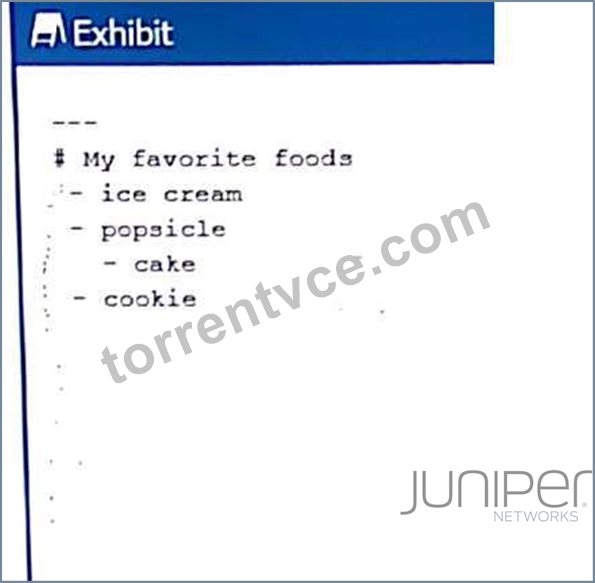
You are asked to create a block of code containing a list of desserts.
What would you do to correct the YAML block shown in the exhibit?
- A. The YAML block should not have a comment
- B. The item - ice cream should be in quotes.
- C. The YAML block should start with # /bash/bin.
- D. The item - cake should not be indented.
Answer: D
NEW QUESTION # 38
Which two statements about Junos PyEZ RPC(s) are correct? (Choose two.)
- A. PyEZ RPCs can be used to view the active device configuration
- B. PyEZ RPCs can be used to view only the interface configuration
- C. PyEZ RPCs return XML data
- D. PyEZ RPCs return CSV data
Answer: B,C
NEW QUESTION # 39
Which two statements are correct about a Python list data type? (Choose two.)
- A. The data contained in a list data type cannot be modified.
- B. The data contained in a list data type is not sequenced or indexed.
- C. The data contained in a list data type is sequenced and indexed starting from 0.
- D. The data contained in a list data type can be modified.
Answer: C,D
Explanation:
Python lists have the following characteristics:
* Modifiable Data (A): Lists are mutable, meaning you can change, add, or remove elements after the list has been created.
* Sequenced and Indexed (B): Lists maintain the order of their elements and are indexed starting from 0.
This means you can access elements by their position in the list.
Option C is incorrectbecause lists are mutable, allowing modifications.Option D is incorrectbecause lists are indeed sequenced and indexed, unlike dictionaries.
* Python Official Documentation: Covers the properties of lists, including mutability and indexing.
* Python Data Structures Guide: Explains list operations and how to manipulate them.
References:
NEW QUESTION # 40
Which statement is correct about DevOps?
- A. DevOps is meant to define and restrict the development and operations tools used for a project.
- B. DevOps is a collection of strict guidelines that promotes the project completion over all other aspects.
- C. DevOps is a defined standard written and maintained by the IEEE standards group.
- D. DevOps is meant to unite the development, operations, and other teams to improve project collaborations.
Answer: D
Explanation:
DevOps is a set of practices, tools, and cultural philosophies that aims to integrate and automate the processes between software development and IT operations teams. The primary goal of DevOps is to shorten the systems development life cycle and provide continuous delivery with high software quality.
Option C is correct because DevOps fundamentally focuses on breaking down the silos between development and operations teams, fostering a collaborative environment where these teams work together throughout the entire software lifecycle. This collaboration extends to other stakeholders, including quality assurance (QA), security, and more, to ensure that the product is continuously delivered and improved based on real-time feedback.
DevOps promotes a cultural shift where teams are no longer isolated but work together to share responsibilities, which leads to increased efficiency, faster problem resolution, and a more streamlined deployment process. This culture of collaboration is supported by various automation tools and practices such as Continuous Integration (CI), Continuous Deployment (CD), Infrastructure as Code (IaC), and automated testing.
Supporting References:
* Juniper Networks Automation and DevOps Documentation:This documentation emphasizes the importance of collaboration between development and operations teams to streamline processes and improve efficiency, aligning perfectly with the principles of DevOps.
* "The DevOps Handbook"by Gene Kim, Patrick Debois, John Willis, and Jez Humble: This book provides an in-depth look into how DevOps practices enhance collaboration and lead to faster, more reliable software delivery.
* IEEE and Industry Standards:While DevOps practices are widely adopted, they are not defined or maintained by IEEE or any other formal standards body, which is why option D is incorrect.
NEW QUESTION # 41
Exhibit.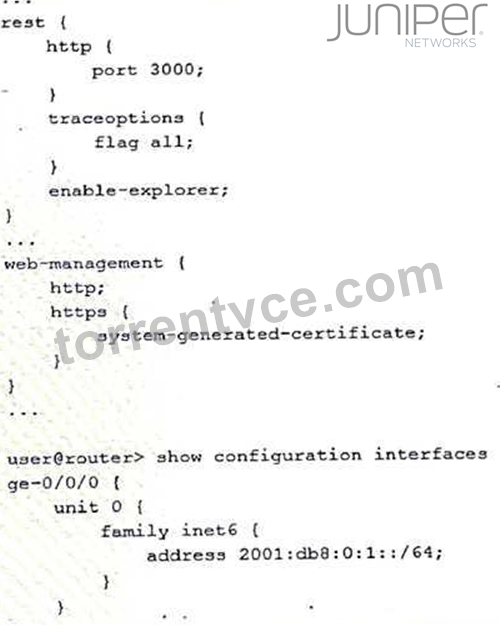
You have the configuration shown in the exhibit, but are unable to access the REST API Explorer.
Which configuration is necessary to solve this problem?
- A. Configure a secondary IPv6 address on ge-0/0/0.0.
- B. Configure the rest service to be active on port 80.
- C. Configure an IPv4 address on ge-0/0/0 0.
- D. Configure a firewall filter to explicitly permit SSH.
Answer: A
NEW QUESTION # 42
Exhibit.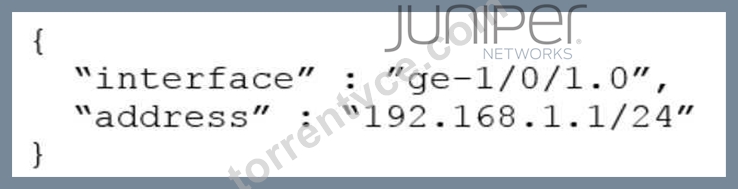
Referring to the exhibit, this snippet of code would represent which type of data?
- A. JSON array
- B. JSON object
- C. YAML sequence
- D. YAML mapping
Answer: B
Explanation:
Reference: https://www.juniper.net/documentation/en_US/junos-salt/topics/topic-map/junos-salt- configurationloading-commiting.html
NEW QUESTION # 43
Given the following Python script:
a = [1,2,3,4,5,6,7,8,9]
print(a[0])
What is the output of this print command?
- A. 0
- B. 1
- C. 2
- D. 3
Answer: D
Explanation:
In Python, lists are zero-indexed, meaning the first element of the list is at index 0. The given script is:
pythona = [1, 2, 3, 4, 5, 6, 7, 8, 9]
print(a[0])
a[0] refers to the first element in the list a, which is 1.
So, the output of the print(a[0]) command is 1.
Option A is correct because Python indexing starts at 0, making the first element of the list at index 0.
Reference:
Python Official Documentation: Covers list indexing and operations.
Python Programming Tutorials: Provide examples of list indexing.
NEW QUESTION # 44
Which process is responsible for JET automation requests?
- A. jsrpd
- B. jsd
- C. mgd
- D. rpd
Answer: B
Explanation:
Thejsd(Junos Script Daemon) process is responsible for handlingJET (Junos Extension Toolkit)automation requests. The JET framework allows for more programmable interactions with Junos devices, using APIs to manage and automate network functions. The jsd process handles these API requests, executes the relevant scripts, and interacts with the Junos configuration and operational states accordingly.
JET enables developers to write applications that interact with the Junos OS through APIs, providing a powerful tool for network automation, monitoring, and configuration management. The jsd process ensures that all JET-related operations are processed and executed properly.
Why the Other Options Are Incorrect:
* A. jsrpd:This is not a process associated with JET automation requests.
* B. mgd:The mgd process is responsible for handling management tasks like CLI commands and configuration changes but is not directly responsible for JET automation requests.
* C. rpd:The rpd (Routing Protocol Daemon) manages routing protocols like BGP and OSPF but has no involvement in JET automation.
References from Juniper Documentation:
* Juniper's documentation on JET and the jsd process outlines how this daemon manages script and API request processing for automation tasks.
NEW QUESTION # 45
What will determine which data serialization format is used for interfacing with a system?
- A. the operating system
- B. programming language version
- C. IDE specifications
- D. the system's API
Answer: D
NEW QUESTION # 46
Which two data structures are used in JSON? (Choose two.)
- A. objects
- B. arrays
- C. dictionaries
- D. tuples
Answer: A,B
Explanation:
In JSON (JavaScript Object Notation), the two primary data structures are:
Objects: These are collections of key-value pairs, where each key is a string, and the value can be a string, number, array, boolean, or another object. In Python, this structure is analogous to a dictionary.
Arrays: These are ordered lists of values, where each value can be of any data type, including another array or object. In Python, this structure is similar to a list.
Option A (tuples) and Option D (dictionaries) refer to Python-specific data structures and are not directly used in JSON.
Supporting Reference:
JSON Documentation and Tutorials: JSON objects and arrays are the standard data structures used in this format, as described in many tutorials and the official JSON documentation.
NEW QUESTION # 47
Which statement about using Ansible with a Junos device is correct?
- A. SFTP must be used to allow communication between the Ansible control server and the Junos device
- B. Ansible modules are executed on the control server
- C. An Ansible playbook is a set of tasks written in XML
- D. An Ansible agent must be installed and running on the Junos device
Answer: B
NEW QUESTION # 48
What is the advantage of using the REST API?
- A. By default, the REST API retrieves data from a Junos device in HTML format
- B. By default, the REST API retrieves data from a Junos device in CSV format
- C. The REST API enables Junos devices to participate in other REST management system environments
- D. The REST API is enabled by default on all Junos devices
Answer: C
Explanation:
since REST API Retrieve configuration information in XML, ASCII (plain text), or JSON, it retrieve operational data in XML, ASCII, or JSON. And you need to set the service to enable the rest API.
Guide : https://www.juniper.net/documentation/us/en/software/junos/rest-api/topics/concept/rest- api-overview.html
NEW QUESTION # 49
What is the correct sequence for Python script execution?
- A. The byte code is executed in runtime, the code is interpreted, and then the code is translated to byte code.
- B. The code is interpreted, the code is translated to byte code, and then the byte code is executed in runtime.
- C. The code is translated to byte code, the byte code is executed in runtime, and then the code is interpreted.
- D. The code is translated to byte code, the code is interpreted, and then the byte code is executed in runtime.
Answer: B
Explanation:
Python follows a specific execution flow when a script is run:
* The code is interpreted:Python is an interpreted language, meaning that the Python interpreter reads the code line by line. When a Python script is executed, the interpreter first reads the source code.
* The code is translated to bytecode:After interpreting the source code, Python translates it into bytecode. Bytecode is an intermediate representation of the source code that is portable and efficient for execution by the Python Virtual Machine (PVM).
* The bytecode is executed in runtime:Finally, thePython Virtual Machine (PVM)executes the bytecode. The PVM is a part of the Python runtime environment, responsible for interpreting the bytecode into machine-specific instructions for execution.
Hence, the correct sequence is:interpreted # translated to bytecode # bytecode executed in runtime.
Why the Other Options Are Incorrect:
* Options A, C, and D present an incorrect order of the script execution process, especially in how bytecode is generated and executed.
References:
* Python's documentation on the interpreter and its execution model explains this standard process.
NEW QUESTION # 50
Which feature is used in XML to ensure that all attributes and elements have unique names?
- A. selectors
- B. XPath
- C. predicate
- D. namespace
Answer: B
NEW QUESTION # 51
A REST API client uses which two HTTP methods to execute RPC requests on the server? (Choose two.)
- A. POST
- B. HEAD
- C. GET
- D. CONNECT
Answer: A,C
Explanation:
REST APIs use HTTP methods to perform different operations on resources. In the context of RPC (Remote Procedure Call) requests:
GET: This method is used to retrieve data from the server. In a REST API, it is commonly used to fetch information about resources, such as the current configuration or operational state.
POST: This method is used to send data to the server to create or update a resource. In the context of RPC, POST is often used to execute a procedure on the server that may result in the modification of a resource or triggering of an action.
Options B (HEAD) and D (CONNECT) are not typically used for executing RPC requests:
HEAD is similar to GET but only retrieves the headers, not the body of the response.
CONNECT is used to establish a tunnel to the server, primarily for SSL-encrypted communication, and is not commonly associated with RESTful RPC operations.
Supporting Reference:
Juniper Networks REST API Documentation: The documentation provides detailed information about the use of HTTP methods in Juniper's RESTful services.
"RESTful Web Services" by Leonard Richardson and Sam Ruby: This book explains the principles of REST and how different HTTP methods, particularly GET and POST, are used to interact with RESTful APIs.
NEW QUESTION # 52
Which two programming languages are used for Junos on-box scripting? (Choose two.)
- A. SLAX
- B. Ruby
- C. XSLT
- D. Perl
Answer: A,C
Explanation:
Junos on-box scripting supports the following programming languages:
SLAX (C): SLAX (Structured Language for XML) is a scripting language designed specifically for Junos devices. It allows for easy manipulation of XML data, making it ideal for creating Junos scripts that interact with device configurations.
XSLT (D): XSLT (Extensible Stylesheet Language Transformations) is another language used for transforming XML documents into other formats. It is commonly used in Junos for transforming XML data into different views or outputs.
Options A (Perl) and B (Ruby) are not used for Junos on-box scripting. While these languages are popular in other contexts, Junos scripting relies heavily on XML-based languages like SLAX and XSLT.
Reference:
Junos XML API and Scripting Guide: Describes the use of SLAX and XSLT for on-box scripting.
Juniper Networks Automation Documentation: Provides examples and best practices for using SLAX and XSLT in Junos scripting.
NEW QUESTION # 53
Which two statements about Python lists are correct? (Choose two.)
- A. Lists can contain elements of multiple data types.
- B. Lists contain a countable number of unordered values.
- C. Lists must contain only elements of the same data type.
- D. Lists contain a countable number of ordered values
Answer: A,D
NEW QUESTION # 54
......
Juniper JN0-223 (Automation and DevOps, Associate (JNCIA-DevOps)) Exam is an excellent certification for IT professionals who are interested in automation and DevOps. By passing JN0-223 exam, you can demonstrate your knowledge and skills in these areas and position yourself for career advancement in the IT industry.
Reliable Study Materials for JN0-223 Exam Success For Sure: https://www.torrentvce.com/JN0-223-valid-vce-collection.html
Get Unlimited Access to JN0-223 Certification Exam Cert Guide: https://drive.google.com/open?id=1Q2HsZj7_EG5ekt7Sn_iMsRVYKWFXEhsw