

PECB Certified ISO-IEC-27001-Lead-Auditor Dumps Questions Valid ISO-IEC-27001-Lead-Auditor Materials
Current ISO-IEC-27001-Lead-Auditor Exam Dumps [2024] Complete PECB Exam Smoothly
In order to prepare for the exam, candidates are advised to review the ISO/IEC 27001 standard and to familiarize themselves with the key concepts and terminology used in information security management. They should also review relevant case studies and practical scenarios to gain a better understanding of how the concepts covered in the exam can be applied in the real world.
PECB ISO-IEC-27001-Lead-Auditor certification is highly respected in the information security industry and is recognized globally as a mark of excellence. Professionals who hold this certification are in high demand, as they have demonstrated their ability to conduct effective ISMS audits and provide valuable insights into an organization's security posture. PECB Certified ISO/IEC 27001 Lead Auditor exam certification is ideal for auditors, consultants, or security professionals who want to enhance their skills and advance their careers in the field of information security.
NEW QUESTION # 111
You are performing an ISMS audit at a residential nursing home called ABC that provides healthcare services.
You find all nursing home residents wear an electronic wristband for monitoring their location, heartbeat, and blood pressure always. You learned that the electronic wristband automatically uploads all data to the artificial intelligence (AI) cloud server for healthcare monitoring and analysis by healthcare staff.
To verify the scope of ISMS, you interview the management system representative (MSR) who explains that the ISMS scope covers an outsourced data center.
Select three options for the audit evidence you need to find to verify the scope of the ISMS.
- A. The auditee is considering the purchase of a healthcare monitoring app from an external software company
- B. The auditee has identified the resident's needs and expectations on the facility and environmental safety
- C. The auditee has identified the governmental authorities' needs and expectations on healthcare services and patient data handling
- D. The auditee has identified the resident's needs and expectations on the comfort facility, medical professional's competence, and clean environment
- E. The IT service agreement with the data center where the artificial intelligence (AI) cloud server is located
- F. The auditee has identified the resident's needs and expectations on healthcare medical treatment services
- G. The auditee has ISO 9001 certification
- H. The auditee has identified the resident's needs and expectations on how they should protect the resident's personal data
Answer: C,E,H
Explanation:
Explanation
According to ISO 27001:2022 clause 4.3, the organisation shall determine the scope of the information security management system (ISMS) by considering the internal and external issues, the requirements of interested parties, and the interfaces and dependencies with other organisations12 In this case, the ISMS scope covers an outsourced data center that hosts the artificial intelligence (AI) cloud server for healthcare monitoring and analysis of the residents' data. Therefore, the audit evidence you need to find to verify the scope of the ISMS should include:
The auditee has identified the governmental authorities' needs and expectations on healthcare services and patient data handling. This is an external issue and an interested party requirement that affects the ISMS scope, as the auditee has to comply with the relevant laws and regulations regarding the quality, safety, and privacy of healthcare services and patient data12 The auditee has identified the resident's needs and expectations on how they should protect the resident's personal data. This is an external issue and an interested party requirement that affects the ISMS scope, as the auditee has to ensure the confidentiality, integrity, and availability of the resident's personal data that is collected, processed, and stored by the electronic wristband and the AI cloud server12 The IT service agreement with the data center where the artificial intelligence (AI) cloud server is located. This is an interface and dependency with another organisation that affects the ISMS scope, as the auditee has to control the externally provided processes, products, and services that are relevant to the ISMS, and to implement appropriate contractual requirements related to information security12 The following options are not relevant or sufficient for verifying the scope of the ISMS:
The auditee has identified the resident's needs and expectations on the facility and environmental safety.
This is an external issue and an interested party requirement, but it does not affect the ISMS scope, as it is not related to information security12 The auditee has ISO 9001 certification. This is an indication of the auditee's quality management system, but it does not verify the scope of the ISMS, as it is not related to information security12 The auditee has identified the resident's needs and expectations on the comfort facility, medical professional's competence, and clean environment. These are external issues and interested party requirements, but they do not affect the ISMS scope, as they are not related to information security12 The auditee has identified the resident's needs and expectations on healthcare medical treatment services. These are external issues and interested party requirements, but they do not verify the scope of the ISMS, as they are not specific to information security12 The auditee is considering the purchase of a healthcare monitoring app from an external software company. This is a potential change that may affect the ISMS scope in the future, but it does not verify the current scope of the ISMS, as it is not yet implemented or controlled12 References:
1: ISO/IEC 27001:2022 Lead Auditor (Information Security Management Systems) Course by CQI and IRCA Certified Training 1 2: ISO/IEC 27001 Lead Auditor Training Course by PECB 2
NEW QUESTION # 112
What type of system ensures a coherent Information Security organisation?
- A. Information Exchange Data System (IEDS)
- B. Information Technology Service Management System (ITSM)
- C. Federal Information Security Management Act (FISMA)
- D. Information Security Management System (ISMS)
Answer: D
NEW QUESTION # 113
Select the words that best complete the sentence:
To complete the sentence with the word(s) click on the blank section you want to complete so that it is highlighted in red, and then click on the application text from the options below. Alternatively, you may drag and drop the option to the appropriate blank section.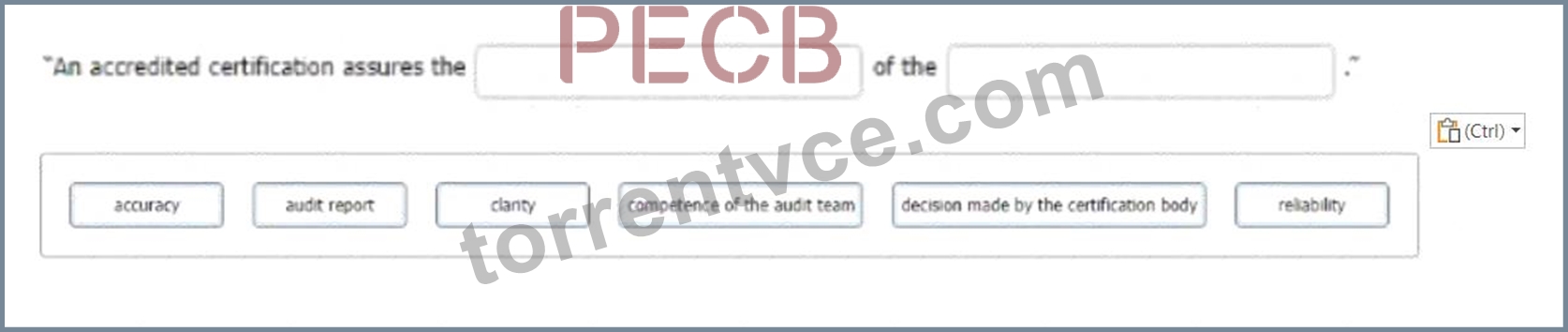
Answer:
Explanation: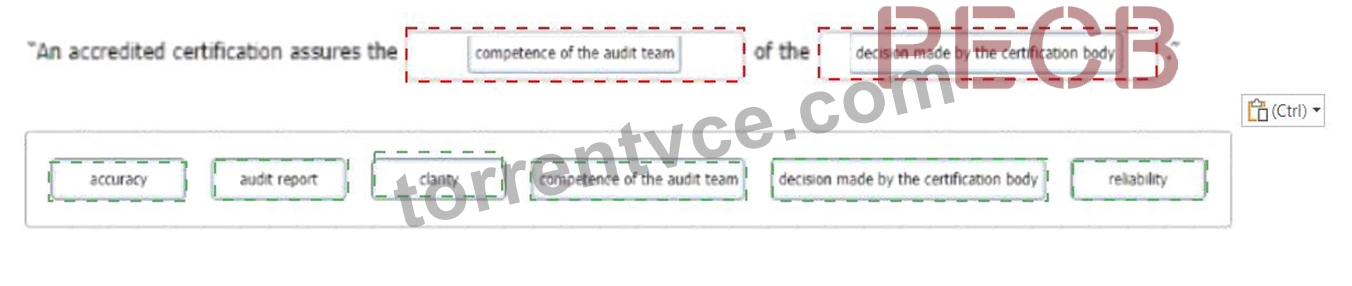
Explanation
competence of the audit team and decision made by the certification body According to ISO/IEC 17021-1, which specifies the requirements for bodies providing audit and certification of management systems, an accredited certification means that the certification body has been evaluated by an accreditation body against recognized standards to demonstrate its competence, impartiality and performance capability1. Therefore, an accredited certification assures the competence of the audit team that conducts the audit in accordance with ISO 19011 and ISO/IEC 27001:2022, and the decision made by the certification body that grants or maintains the certification based on the audit evidence and findings2. References: ISO/IEC
17021-1:2015 - Conformity assessment - Requirements for bodies providing audit and certification of management systems - Part 1: Requirements, ISO/IEC 27001:2022 Lead Auditor (Information Security Management Systems) | CQI | IRCA
NEW QUESTION # 114
The following are purposes of Information Security, except:
- A. Minimize Business Risk
- B. Ensure Business Continuity
- C. Increase Business Assets
- D. Maximize Return on Investment
Answer: C
NEW QUESTION # 115
You are an ISMS audit team leader who has been assigned by your certification body to carry out a follow-up audit of a client. You are preparing your audit plan for this audit.
Which two of the following statements are true?
- A. Verification should focus on whether any action undertaken has been undertaken effectively
- B. Corrections should be verified first, followed by corrective actions and finally opportunities for improvement
- C. Verification should focus on whether any action undertaken taken has been undertaken efficiently
- D. Verification should focus on whether any action undertaken is complete
- E. Opportunities for improvement should be verified first, followed by corrections and finally corrective actions
- F. Corrective actions should be reviewed first, followed by corrections and finally opportunities for improvement
Answer: A,D
Explanation:
Explanation
According to ISO 27001:2022 clause 9.1.2, the organisation shall conduct internal audits at planned intervals to provide information on whether the information security management system conforms to the organisation's own requirements, the requirements of ISO 27001:2022, and is effectively implemented and maintained12 According to ISO 27001:2022 clause 10.1, the organisation shall react to the nonconformities and take action, as applicable, to control and correct them and deal with the consequences. The organisation shall also evaluate the need for action to eliminate the causes of nonconformities, in order to prevent recurrence or occurrence.
The organisation shall implement any action needed, review the effectiveness of any corrective action taken, and make changes to the information security management system, if necessary12 A follow-up audit is a type of internal audit that is conducted after a previous audit to verify whether the nonconformities and corrective actions have been addressed and resolved, and whether the information security management system has been improved12 Therefore, the following statements are true for preparing a follow-up audit plan:
* Verification should focus on whether any action undertaken is complete. This means that the auditor should check whether the organisation has implemented all the planned actions to correct and prevent the nonconformities, and whether the actions have been documented and communicated as required12
* Verification should focus on whether any action undertaken has been undertaken effectively. This means that the auditor should check whether the organisation has achieved the intended results and objectives of the actions, and whether the actions have eliminated or reduced the nonconformities and their causes and consequences12 The following statements are false for preparing a follow-up audit plan:
* Verification should focus on whether any action undertaken has been undertaken efficiently. This is false because efficiency is not a criterion for verifying the actions taken to address the nonconformities and corrective actions. Efficiency refers to the optimal use of resources to achieve the desired outcomes, but it is not a requirement of ISO 27001:2022. The auditor should focus on the effectiveness and completeness of the actions, not on the efficiency12
* Corrections should be verified first, followed by corrective actions and finally opportunities for improvement. This is false because there is no prescribed order for verifying the corrections, corrective actions, and opportunities for improvement. The auditor should verify all the actions taken by the organisation, regardless of their sequence or priority. The auditor may choose to verify the actions based on their relevance, significance, or impact, but this is not a mandatory requirement12
* Opportunities for improvement should be verified first, followed by corrections and finally corrective actions. This is false because there is no prescribed order for verifying the opportunities for improvement, corrections, and corrective actions. The auditor should verify all the actions taken by the organisation, regardless of their sequence or priority. The auditor may choose to verify the actions based on their relevance, significance, or impact, but this is not a mandatory requirement12
* Corrective actions should be reviewed first, followed by corrections and finally opportunities for improvement. This is false because there is no prescribed order for reviewing the corrective actions, corrections, and opportunities for improvement. The auditor should review all the actions taken by the organisation, regardless of their sequence or priority. The auditor may choose to review the actions based on their relevance, significance, or impact, but this is not a mandatory requirement12 References:
1: ISO/IEC 27001:2022 Lead Auditor (Information Security Management Systems) Course by CQI and IRCA Certified Training 1 2: ISO/IEC 27001 Lead Auditor Training Course by PECB 2
NEW QUESTION # 116
You are an experienced ISMS audit team leader guiding an auditor in training. You are testing her understanding of follow-up audits by asking her a series of questions to which the answer is either "true* or
'false'. Which four of the following questions should the answer be true"'
- A. The outcome of a follow-up audit could be a recommendabon to suspend the client's certification
- B. The outcomes of a follow-up audit should be reported to the individual managing the audit programme and the audit client
- C. A follow-up audit may be carried out where nonconformities are minor
- D. A follow-up audit may be carried out where nonconformities are major
- E. The outcome of a follow-up audit could lower a major nonconformity to minor status
- F. A follow-up audit is required in all instances where nonconformities have been identified
- G. The outcomes of a follow-up audit should be reported to top management and the audit team leader who carried out the audit where the nonconformities were initially identified
- H. A follow-up audit is required only in instances where a major nonconformity has been identified
Answer: B,C,D,G
Explanation:
Explanation
A follow-up audit may be carried out where nonconformities are major. This is true because a major nonconformity is a situation that raises significant doubt about the ability of the organization's management system to achieve its intended results, and therefore requires immediate corrective action. A follow-up audit is necessary to verify the effectiveness of the corrective action and the conformity of the management system12.
A follow-up audit may be carried out where nonconformities are minor. This is true because a minor nonconformity is a situation that does not affect the capability of the management system to achieve its intended results, but represents a deviation from the specified requirements. A follow-up audit may be conducted to check the implementation of the corrective action and the improvement of the management system12.
The outcomes of a follow-up audit should be reported to top management and the audit team leader who carried out the audit where the nonconformities were initially identified. This is true because the top management is responsible for ensuring the effectiveness and continual improvement of the management system, and the audit team leader is accountable for the audit process and the audit conclusions. The follow-up audit report should provide them with objective evidence of the status of the nonconformities and the corrective actions taken by the auditee13.
The outcomes of a follow-up audit should be reported to the individual managing the audit programme and the audit client. This is true because the individual managing the audit programme is responsible for planning, implementing, monitoring and reviewing the audit activities, and the audit client is the organization or person requesting an audit. The follow-up audit report should inform them of the results of the follow-up audit and any changes in the certification status of the auditee13.
References :=
ISO 19011:2022 Guidelines for auditing management systems
ISO/IEC 27001:2022 Information technology - Security techniques - Information security management systems - Requirements ISO/IEC 17021-1:2022 Conformity assessment - Requirements for bodies providing audit and certification of management systems - Part 1: Requirements
NEW QUESTION # 117
A well-executed risk analysis provides a great deal of useful information. A risk analysis has four main objectives.
What is not one of the four main objectives of a risk analysis?
- A. Identifying assets and their value
- B. Establishing a balance between the costs of an incident and the costs of a security measure
- C. Determining relevant vulnerabilities and threats
- D. Implementing counter measures
Answer: D
NEW QUESTION # 118
You receive the following mail from the IT support team: Dear User,Starting next week, we will be deleting all inactive email accounts in order to create spaceshare the below details in order to continue using your account. In case of no response, Name:
Email ID:
Password:
DOB:
Kindly contact the webmail team for any further support. Thanks for your attention.
Which of the following is the best response?
- A. Respond it by saying that one should not share the password with anyone
- B. Ignore the email
- C. One should not respond to these mails and report such email to your supervisor
Answer: C
Explanation:
Explanation
The best response to the email from the IT support team asking for personal details is to not respond to the email and report it to your supervisor. The email is likely a phishing attempt, which is a form of social engineering that uses deceptive emails or other messages to trick recipients into revealing sensitive information, such as passwords, credit card numbers, bank account details, etc. Phishing emails often impersonate legitimate organizations or individuals and create a sense of urgency or curiosity to lure the victims into clicking on malicious links, opening malicious attachments or providing personal information.
The IT support team should never ask for your password or other personal details via email, as this is a violation of information security policies and best practices. Ignoring the email or responding to it by saying that one should not share the password with anyone are not sufficient responses, as they do not alert the IT support team or your supervisor about the phishing attempt, which could affect other users as well. Reporting the email to your supervisor is a responsible action that could help prevent further damage or compromise of information. ISO/IEC 27001:2022 requires the organization to implement awareness and training programs to make users aware of the risks of social engineering attacks, such as phishing, and how to avoid them (see clause A.7.2.2). References: CQI & IRCA Certified ISO/IEC 27001:2022 Lead Auditor Training Course, ISO/IEC 27001:2022 Information technology - Security techniques - Information security management systems - Requirements, What is Phishing?
NEW QUESTION # 119
Select the words that best complete the sentence:
To complete the sentence with the best word(s), click on the blank section you want to complete so that it is highlighted in red, and then click on the applicable text from the options below. Alternatively, you may drag and drop the option to the appropriate blank section.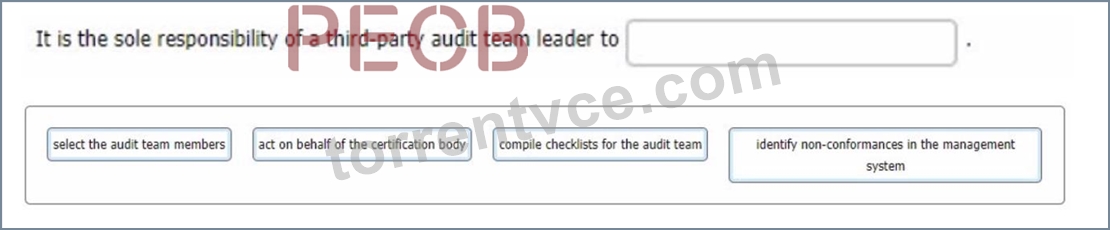
Answer:
Explanation: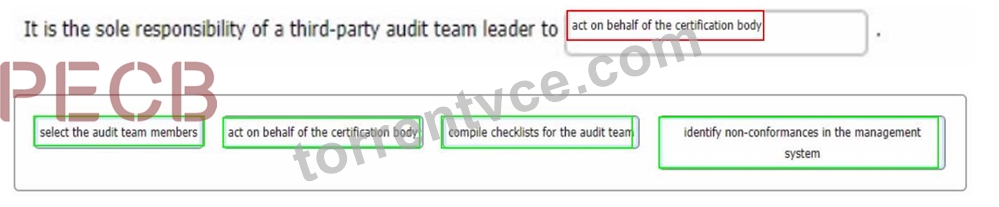
NEW QUESTION # 120
Which of the following is a preventive security measure?
- A. Installing logging and monitoring software
- B. Storing sensitive information in a data save
- C. Shutting down the Internet connection after an attack
Answer: B
Explanation:
A preventive security measure is a measure that aims to prevent or deter potential incidents from occurring, or to reduce their likelihood or impact. A preventive security measure can be a policy, a procedure, a device, a technique or an action that reduces the exposure to threats and vulnerabilities. Storing sensitive information in a data safe is an example of a preventive security measure, because it protects the information from unauthorized access, disclosure, modification or destruction by physical means, such as theft, fire, flood, etc. ISO/IEC 27001:2022 defines preventive control as "control that modifies risk by avoiding an unwanted incident" (see clause 3.19). Reference: [CQI & IRCA Certified ISO/IEC 27001:2022 Lead Auditor Training Course], ISO/IEC 27001:2022 Information technology - Security techniques - Information security management systems - Requirements, [What is Preventive Security?]
NEW QUESTION # 121
Cabling Security is associated with Power, telecommunication and network cabling carrying information are protected from interception and damage.
- A. True
- B. False
Answer: A
NEW QUESTION # 122
What type of compliancy standard, regulation or legislation provides a code of practice for information security?
- A. Computer criminality act
- B. Personal data protection act
- C. IT Service Management
- D. ISO/IEC 27002
Answer: D
Explanation:
Explanation
ISO/IEC 27002:2022 is an international standard that provides a code of practice for information security controls4. A code of practice is a set of guidelines and recommendations for implementing, maintaining, and improving information security in an organization5. ISO/IEC 27002:2022 covers various aspects of information security, such as organizational, human, technical, physical, and environmental controls. It is designed to be used as a reference for selecting, implementing, and managing controls within the process of establishing an ISMS based on ISO/IEC 27001:20224. References: ISO/IEC 27002:2022, Foreword and Introduction; ISO/IEC 27000:2022, clause 3.10.
NEW QUESTION # 123
Changes to the information processing facilities shall be done in controlled manner.
- A. True
- B. False
Answer: A
Explanation:
Explanation
Changes to the information processing facilities shall be done in a controlled manner, according to clause
12.1.2 of ISO/IEC 27001:2022. This is to ensure that the security of information and systems is not compromised by the changes, and that the changes are authorized, documented, tested, and approved before implementation. References: : CQI & IRCA ISO 27001:2022 Lead Auditor Course Handbook, page 63. :
ISO/IEC 27001:2022, clause 12.1.2.
NEW QUESTION # 124
Which one of the following options is the definition of an interested party?
- A. A group or organisation that can interfere in or perceive itself to be interfered with by a management decision
- B. An individual or organisation that can control, be controlled by, or perceive itself to be controlled by a decision or activity
- C. A person or organisation that can affect, be affected by or perceive itself to be affected by a decision or activity
- D. A third party can appeal to an organisation when it perceives itself to be affected by a decision or activity
Answer: C
Explanation:
Explanation
This is the definition of an interested party according to ISO 27001:2013, clause 3.16. An interested party is essentially a stakeholder, i.e., a person or organization that can influence or be influenced by the information security management system (ISMS) or its activities. Interested parties can have different needs and expectations regarding the ISMS, and these should be identified and addressed by the organization.
References:
ISO/IEC 27001:2013, Information technology - Security techniques - Information security management systems - Requirements, clause 3.16 PECB Candidate Handbook ISO 27001 Lead Auditor, page 10 Identifying interested parties and their expectations for an ISO 27001 ISMS Examples of ISO 27001 interested parties
NEW QUESTION # 125
What type of legislation requires a proper controlled purchase process?
- A. Computer criminality act
- B. Government information act
- C. Intellectual property rights act
- D. Personal data protection act
Answer: C
Explanation:
An intellectual property rights act is a type of legislation that requires a proper controlled purchase process. Intellectual property rights are legal rights that protect creations of the mind, such as inventions, literary and artistic works, designs, symbols, names and images. Intellectual property rights can include patents, trademarks, copyrights, trade secrets, etc. A proper controlled purchase process is a process that ensures that the organization obtains valid licenses or permissions from the owners or authorized parties of the intellectual property rights before using or acquiring any intellectual property assets. This process helps to avoid infringing on the intellectual property rights of others, which may result in legal actions, fines, damages or reputational harm. ISO/IEC 27001:2022 requires the organization to comply with relevant legal and contractual obligations related to intellectual property rights (see clause A.18.1.4). Reference: [CQI & IRCA Certified ISO/IEC 27001:2022 Lead Auditor Training Course], ISO/IEC 27001:2022 Information technology - Security techniques - Information security management systems - Requirements, What is Intellectual Property?
NEW QUESTION # 126
Which of the following does a lack of adequate security controls represent?
- A. Vulnerability
- B. Threat
- C. Impact
- D. Asset
Answer: A
Explanation:
A lack of adequate security controls represents a vulnerability, which is a weakness or flaw in an asset or its protection that can be exploited by a threat. A vulnerability can increase the likelihood or impact of a security incident, and therefore should be identified and treated as part of the risk management process. ISO/IEC 27001:2022 defines vulnerability as "the absence or weakness of a safeguard that could be exploited by a threat source" (see clause 3.49). Reference: [CQI & IRCA Certified ISO/IEC 27001:2022 Lead Auditor Training Course], ISO/IEC 27001:2022 Information technology - Security techniques - Information security management systems - Requirements
NEW QUESTION # 127
......
ISO-IEC-27001-Lead-Auditor Premium PDF & Test Engine Files with 195 Questions & Answers: https://www.torrentvce.com/ISO-IEC-27001-Lead-Auditor-valid-vce-collection.html
Get 100% Real ISO-IEC-27001-Lead-Auditor Accurate & Verified Answers As Seen in the Real Exam!: https://drive.google.com/open?id=1g2dwrcHKJt6pQujbuot7onArYoH7BJhB