

[Jan 01, 2025] Get Up-To-Date Real Exam Questions for DP-100 with New Materials
Updated DP-100 Certification Exam Sample Questions
Microsoft DP-100 certification exam is an excellent way for data science professionals to validate their expertise in designing and implementing data science solutions on Microsoft Azure. DP-100 exam is recognized globally and is highly regarded by employers in the field of data science. Designing and Implementing a Data Science Solution on Azure certification is a testament to the candidate's knowledge and expertise in the field of data science and can open up new career opportunities.
NEW QUESTION # 222
You are evaluating a Python NumPy array that contains six data points defined as follows:
data = [10, 20, 30, 40, 50, 60]
You must generate the following output by using the k-fold algorithm implantation in the Python Scikit-learn machine learning library:
train: [10 40 50 60], test: [20 30]
train: [20 30 40 60], test: [10 50]
train: [10 20 30 50], test: [40 60]
You need to implement a cross-validation to generate the output.
How should you complete the code segment? To answer, select the appropriate code segment in the dialog box in the answer area.
NOTE: Each correct selection is worth one point.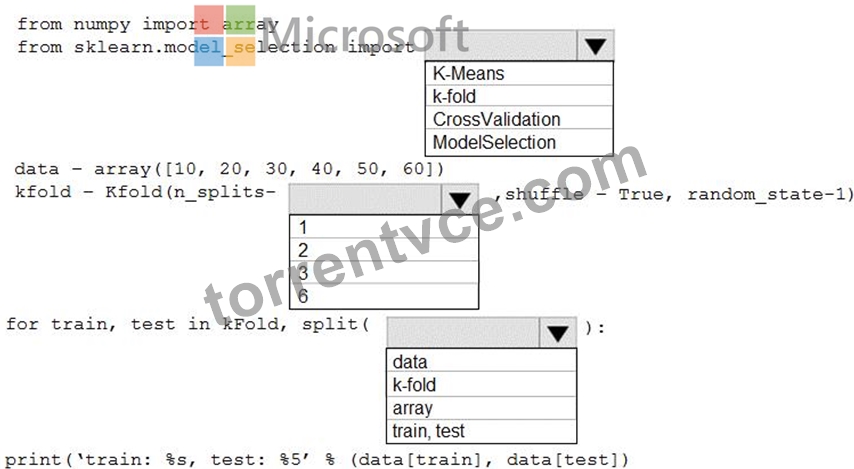
Answer:
Explanation: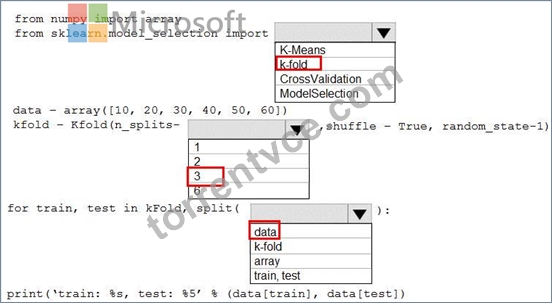
Reference:
https://scikit-learn.org/stable/modules/generated/sklearn.model_selection.KFold.html
NEW QUESTION # 223
You are working on a classification task. You have a dataset indicating whether a student would like to play soccer and associated attributes. The dataset includes the following columns:
You need to classify variables by type.
Which variable should you add to each category? To answer, select the appropriate options in the answer area.
NOTE: Each correct selection is worth one point.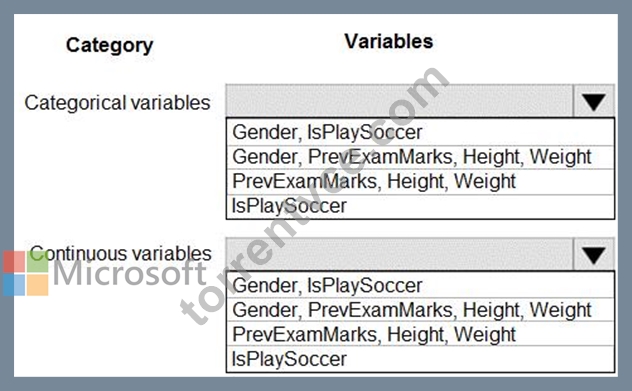
Answer:
Explanation: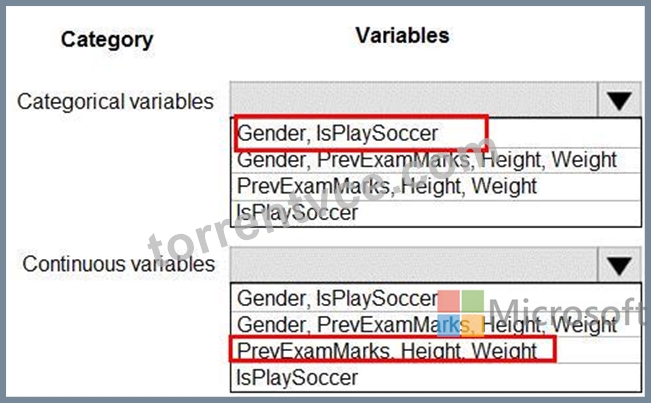
Reference:
https://www.edureka.co/blog/classification-algorithms/
NEW QUESTION # 224
You have a model with a large difference between the training and validation error values.
You must create a new model and perform cross-validation.
You need to identify a parameter set for the new model using Azure Machine Learning Studio.
Which module you should use for each step? To answer, drag the appropriate modules to the correct steps. Each module may be used once or more than once, or not at all. You may need to drag the split bar between panes or scroll to view content.
NOTE: Each correct selection is worth one point.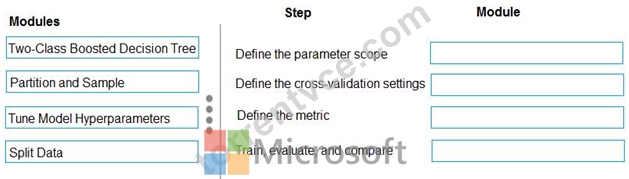
Answer:
Explanation: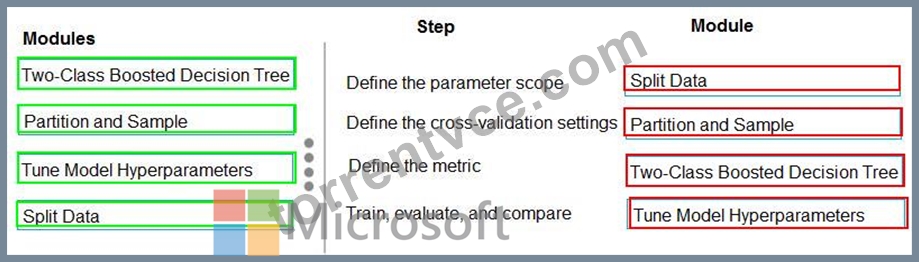
Explanation:
Box 1: Split data
Box 2: Partition and Sample
Box 3: Two-Class Boosted Decision Tree
Box 4: Tune Model Hyperparameters
Integrated train and tune: You configure a set of parameters to use, and then let the module iterate over multiple combinations, measuring accuracy until it finds a "best" model. With most learner modules, you can choose which parameters should be changed during the training process, and which should remain fixed.
We recommend that you use Cross-Validate Model to establish the goodness of the model given the specified parameters. Use Tune Model Hyperparameters to identify the optimal parameters.
References:
https://docs.microsoft.com/en-us/azure/machine-learning/studio-module-reference/partition-and-sample
NEW QUESTION # 225
You are using a decision tree algorithm. You have trained a model that generalizes well at a tree depth equal to 10.
You need to select the bias and variance properties of the model with varying tree depth values.
Which properties should you select for each tree depth? To answer, select the appropriate options in the answer area.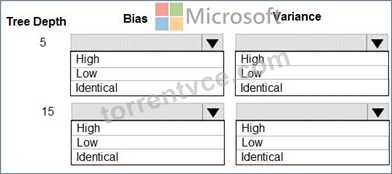
Answer:
Explanation: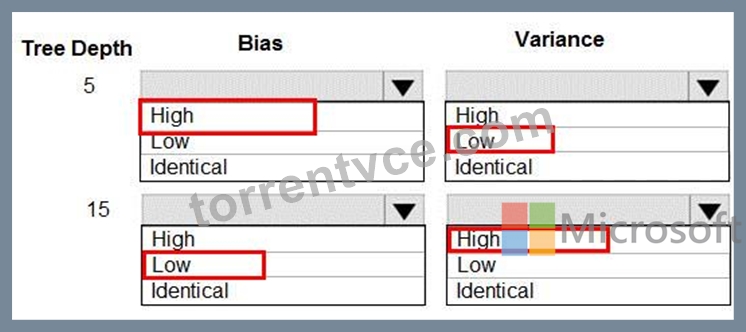
Reference:
https://machinelearningmastery.com/gentle-introduction-to-the-bias-variance-trade-off-in-machine-learning/
NEW QUESTION # 226
You use the following code to run a script as an experiment in Azure Machine Learning:
You must identify the output files that are generated by the experiment run.
You need to add code to retrieve the output file names.
Which code segment should you add to the script?
- A. files= run.get_file_names()
- B. files = run.get_details()
- C. files = run.get_metrics()
- D. files = run.get_properties()
- E. files = run.get_details_with_logs()
Answer: A
Explanation:
You can list all of the files that are associated with this run record by called run.get_file_names() Reference:
https://docs.microsoft.com/en-us/azure/machine-learning/how-to-track-experiments
NEW QUESTION # 227
You create a multi-class image classification deep learning experiment by using the PyTorch framework. You plan to run the experiment on an Azure Compute cluster that has nodes with GPU's.
You need to define an Azure Machine Learning service pipeline to perform the monthly retraining of the image classification model. The pipeline must run with minimal cost and minimize the time required to train the model.
Which three pipeline steps should you run in sequence? To answer, move the appropriate actions from the list of actions to the answer area and arrange them in the correct order.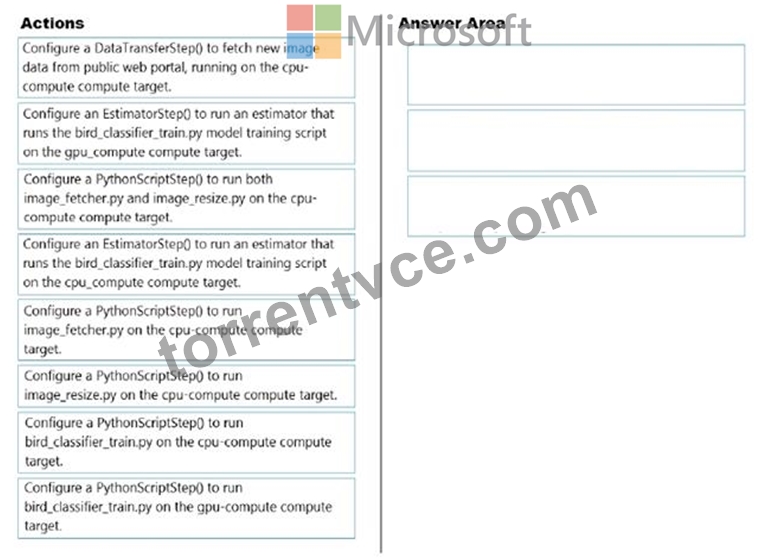
Answer:
Explanation: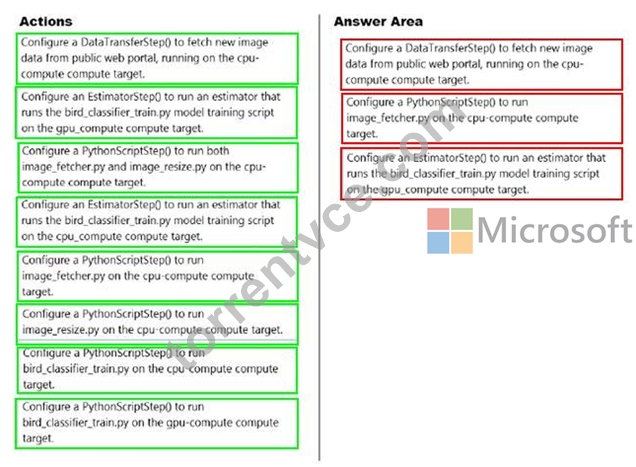
Explanation:
Step 1: Configure a DataTransferStep() to fetch new image data...
Step 2: Configure a PythonScriptStep() to run image_resize.y on the cpu-compute compute target.
Step 3: Configure the EstimatorStep() to run training script on the gpu_compute computer target.
The PyTorch estimator provides a simple way of launching a PyTorch training job on a compute target.
Reference:
https://docs.microsoft.com/en-us/azure/machine-learning/how-to-train-pytorch
NEW QUESTION # 228
You are using The Azure Machine Learning designer to transform a dataset containing the census data of all nations.
You must use the Split Data component to separate the dataset into two datasets. The first dataset must contain the census data of the United States. The second dataset must include the census data of the remaining nations.
You need to configure the component to create the datasets.
Which configuration values should you use? To answer, select the appropriate options in the answer area.
NOTE: Each correct selection is worth one point.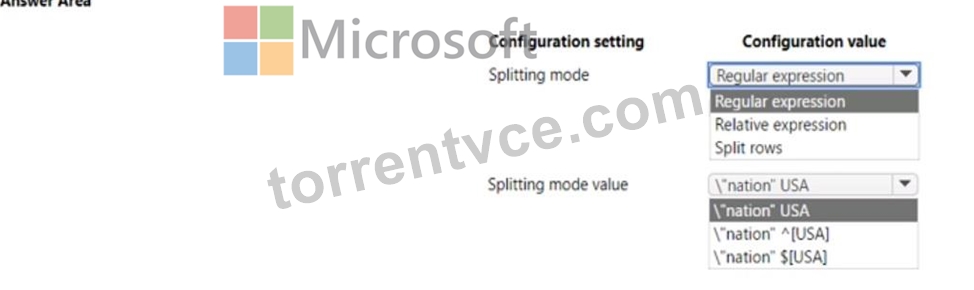
Answer:
Explanation: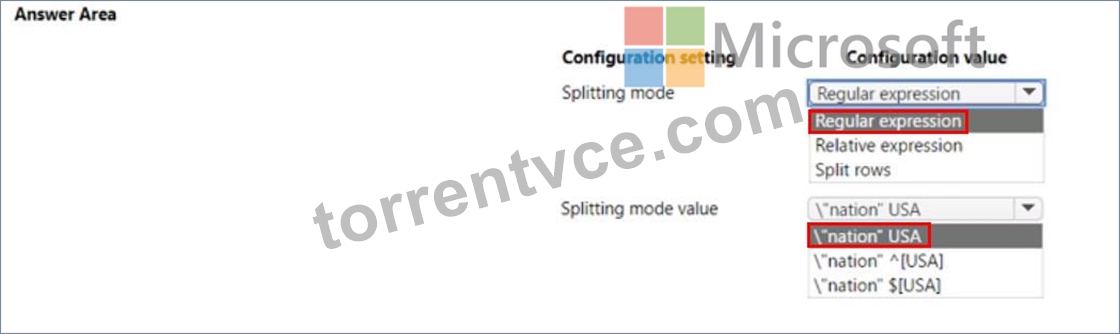
NEW QUESTION # 229
You are performing a classification task in Azure Machine Learning Studio.
You must prepare balanced testing and training samples based on a provided data set.
You need to split the data with a 0.75:0.25 ratio.
Which value should you use for each parameter? To answer, select the appropriate options in the answer area.
NOTE: Each correct selection is worth one point.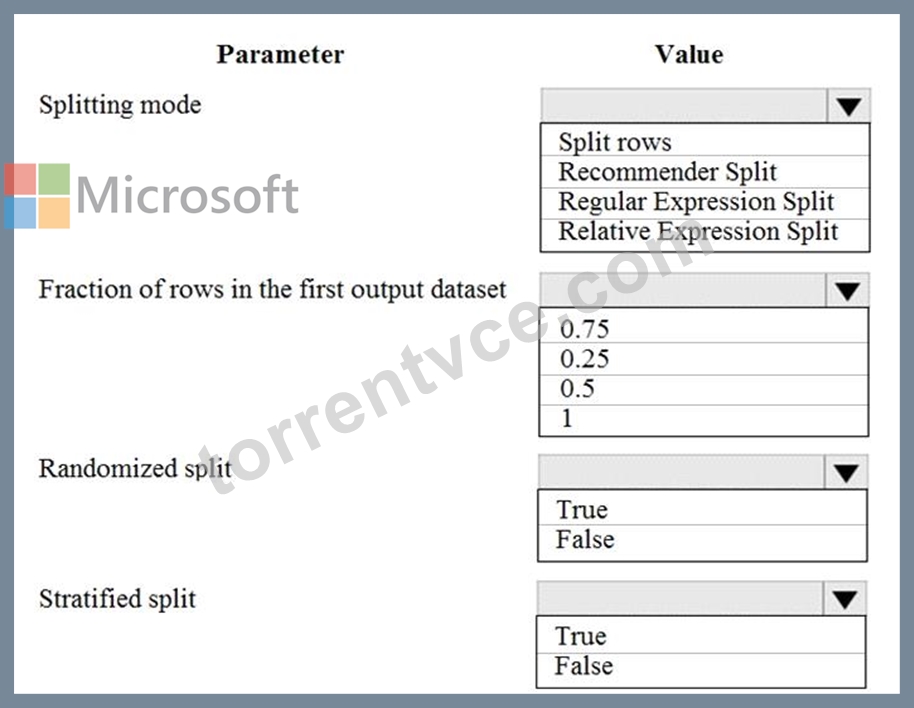
Answer:
Explanation: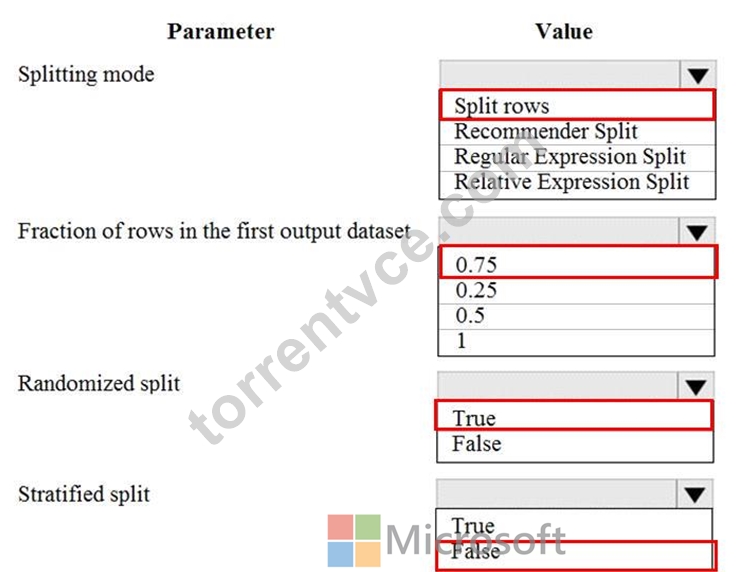
Reference:
https://docs.microsoft.com/en-us/azure/machine-learning/studio-module-reference/split-data
NEW QUESTION # 230
You are developing deep learning models to analyze semi-structured, unstructured, and structured data types.
You have the following data available for model building:
* Video recordings of sporting events
* Transcripts of radio commentary about events
* Logs from related social media feeds captured during sporting events
You need to select an environment for creating the model.
Which environment should you use?
- A. Azure Cognitive Services
- B. Azure Machine Learning Studio
- C. Azure Data Lake Analytics
- D. Azure HDInsight with Spark MLib
Answer: A
Explanation:
Azure Cognitive Services expand on Microsoft's evolving portfolio of machine learning APIs and enable developers to easily add cognitive features - such as emotion and video detection; facial, speech, and vision recognition; and speech and language understanding - into their applications. The goal of Azure Cognitive Services is to help developers create applications that can see, hear, speak, understand, and even begin to reason. The catalog of services within Azure Cognitive Services can be categorized into five main pillars - Vision, Speech, Language, Search, and Knowledge.
References:
https://docs.microsoft.com/en-us/azure/cognitive-services/welcome
NEW QUESTION # 231
You are creating a new Azure Machine Learning pipeline using the designer.
The pipeline must train a model using data in a comma-separated values (CSV) file that is published on a website. You have not created a dataset for this file.
You need to ingest the data from the CSV file into the designer pipeline using the minimal administrative effort.
Which module should you add to the pipeline in Designer?
- A. Enter Data Manually
D - B. Dataset
- C. Import Data
- D. Convert to CSV
Answer: C
Explanation:
Explanation
The preferred way to provide data to a pipeline is a Dataset object. The Dataset object points to data that lives in or is accessible from a datastore or at a Web URL. The Dataset class is abstract, so you will create an instance of either a FileDataset (referring to one or more files) or a TabularDataset that's created by from one or more files with delimited columns of data.
Example:
from azureml.core import Dataset
iris_tabular_dataset = Dataset.Tabular.from_delimited_files([(def_blob_store, 'train-dataset/iris.csv')]) Reference:
https://docs.microsoft.com/en-us/azure/machine-learning/how-to-create-your-first-pipeline
NEW QUESTION # 232
You need to configure the Edit Metadata module so that the structure of the datasets match.
Which configuration options should you select? To answer, select the appropriate options in the answer area.
NOTE: Each correct selection is worth one point.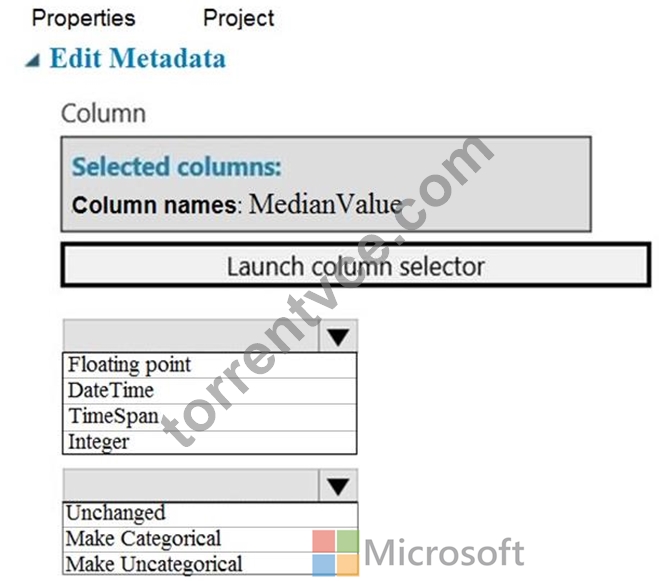
Answer:
Explanation: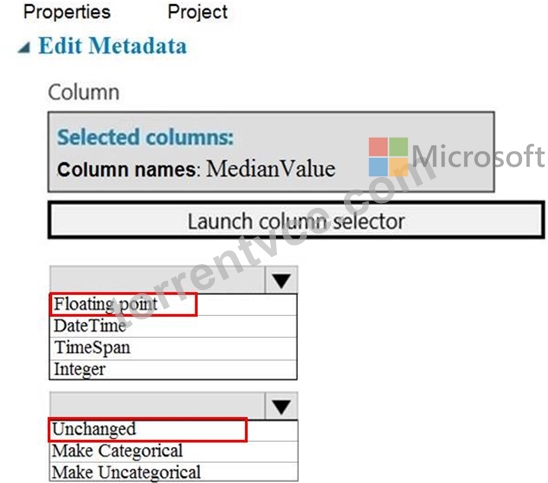
NEW QUESTION # 233
You need to set up the Permutation Feature Importance module according to the model training requirements.
Which properties should you select? To answer, select the appropriate options in the answer area.
NOTE: Each correct selection is worth one point.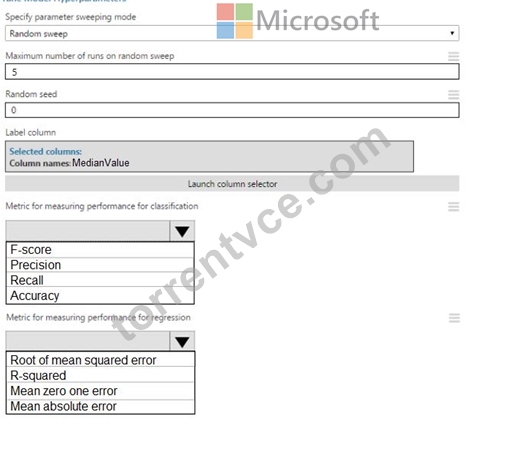
Answer:
Explanation: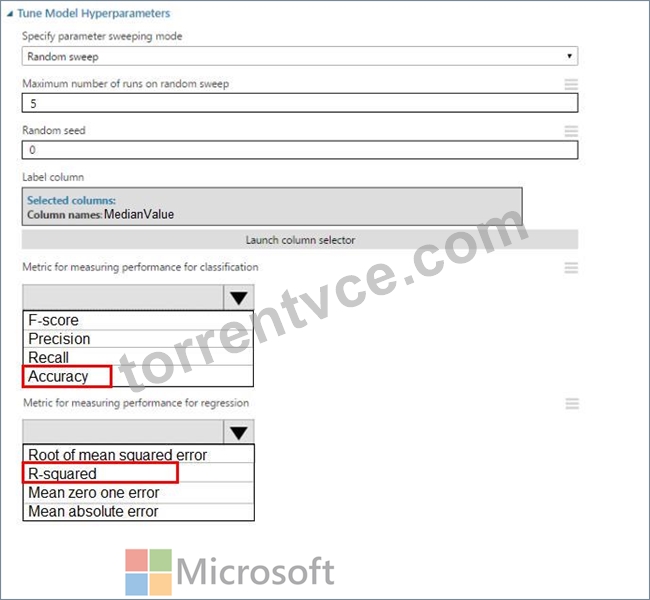
NEW QUESTION # 234
You manage an Azure Machine Learning workspace. You create an experiment named experiment1 by using the Azure Machine Learning Python SDK v2 and MLflow.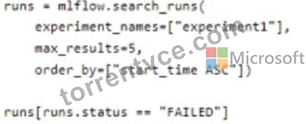
For each of the following statements, select Yes if the statement is true. Otherwise, select No.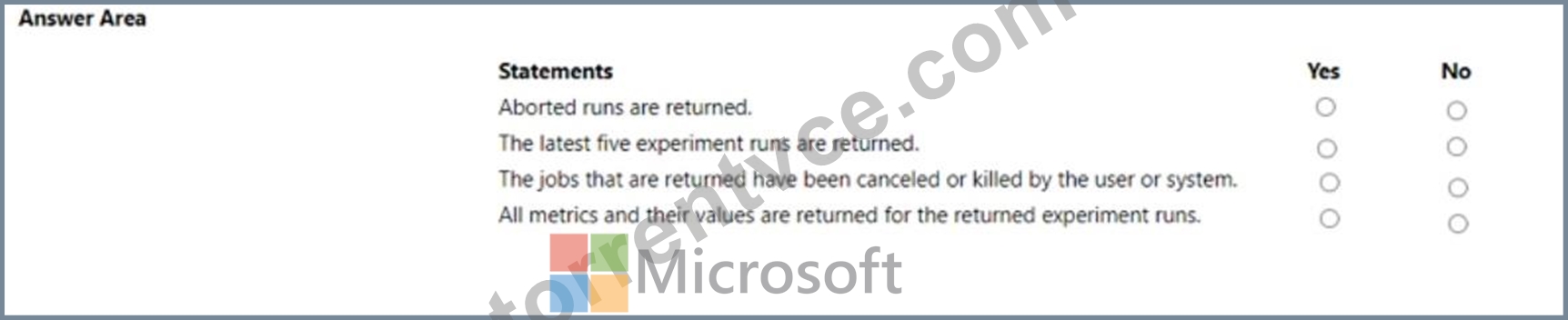
Answer:
Explanation: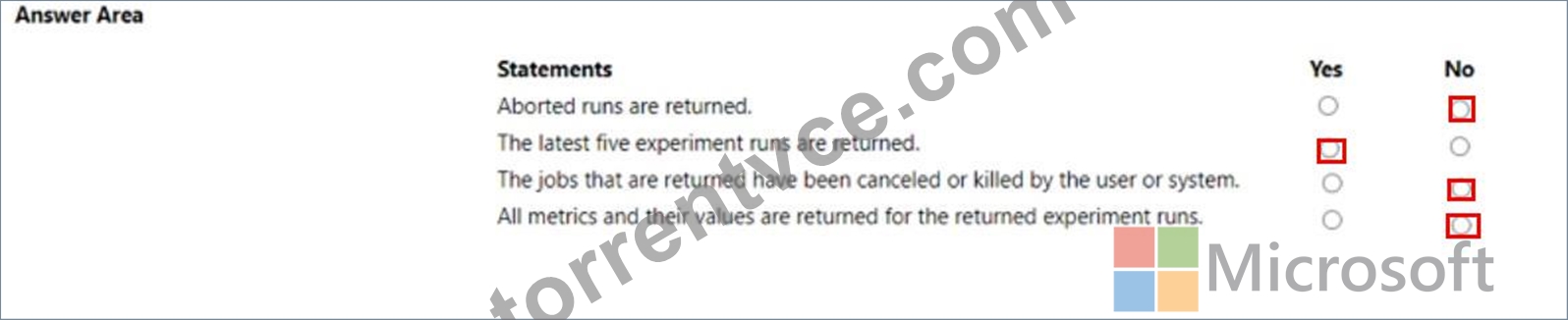
NEW QUESTION # 235
You are using C-Support Vector classification to do a multi-class classification with an unbalanced training dataset. The C-Support Vector classification using Python code shown below:
You need to evaluate the C-Support Vector classification code.
Which evaluation statement should you use? To answer, select the appropriate options in the answer area.
NOTE: Each correct selection is worth one point.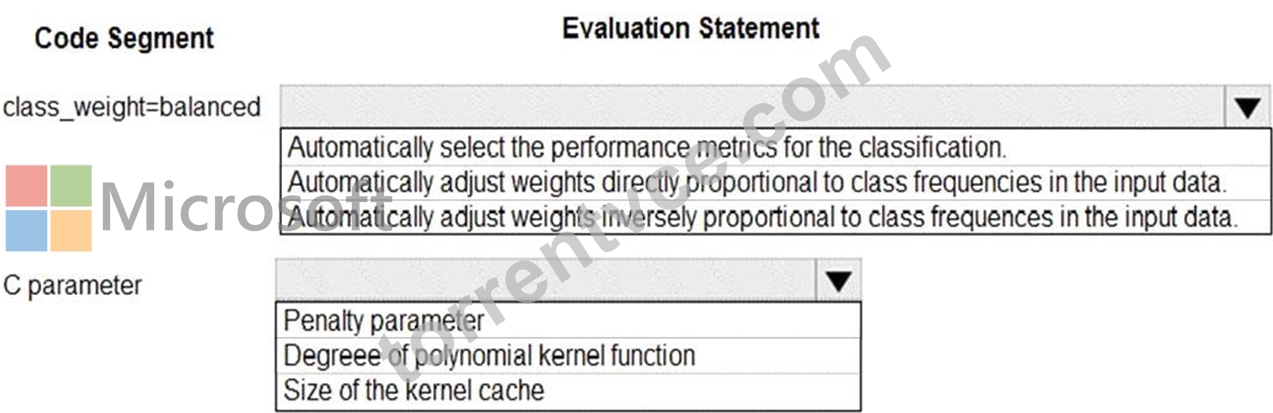
Answer:
Explanation: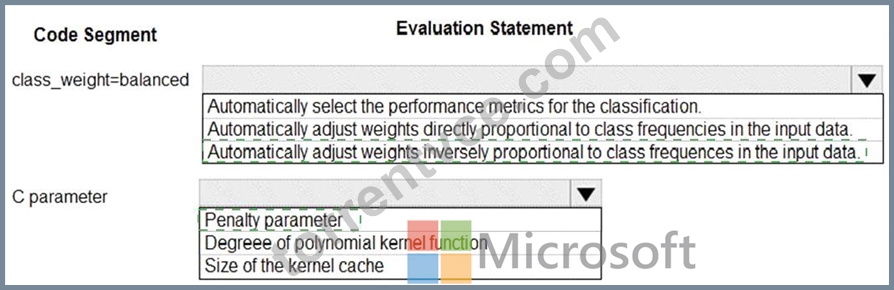
Explanation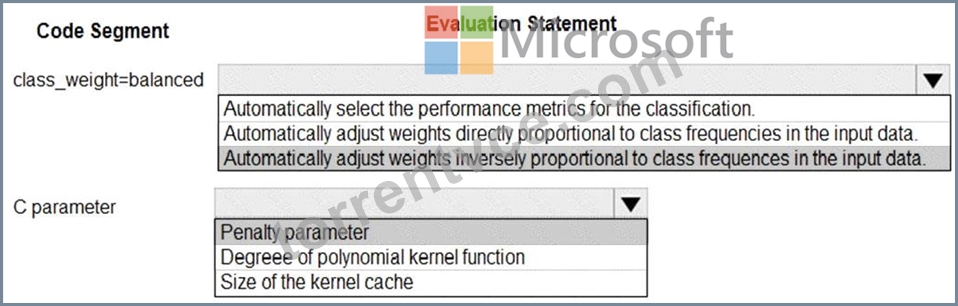
Box 1: Automatically adjust weights inversely proportional to class frequencies in the input data The "balanced" mode uses the values of y to automatically adjust weights inversely proportional to class frequencies in the input data as n_samples / (n_classes * np.bincount(y)).
Box 2: Penalty parameter
Parameter: C : float, optional (default=1.0)
Penalty parameter C of the error term.
References:
https://scikit-learn.org/stable/modules/generated/sklearn.svm.SVC.html
NEW QUESTION # 236
You are hired as a data scientist at a winery. The previous data scientist used Azure Machine Learning.
You need to review the models and explain how each model makes decisions.
Which explainer modules should you use? To answer, select the appropriate options in the answer area.
NOTE: Each correct selection is worth one point.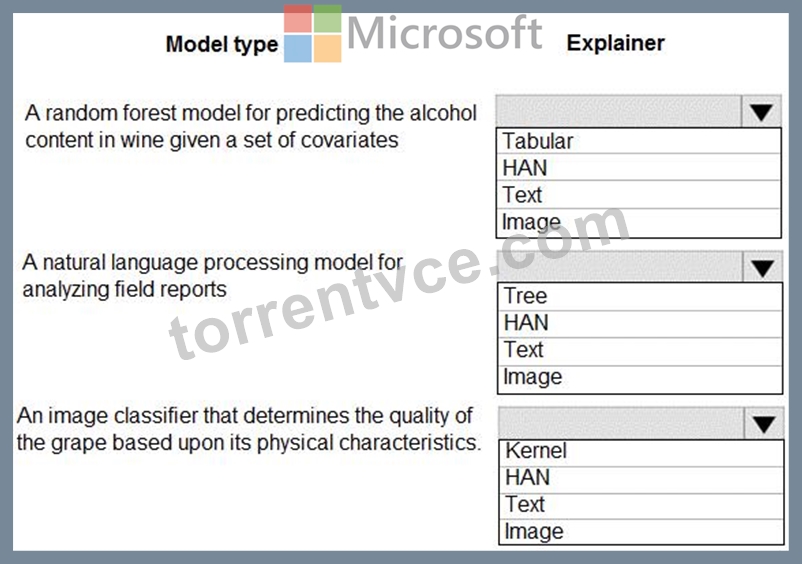
Answer:
Explanation: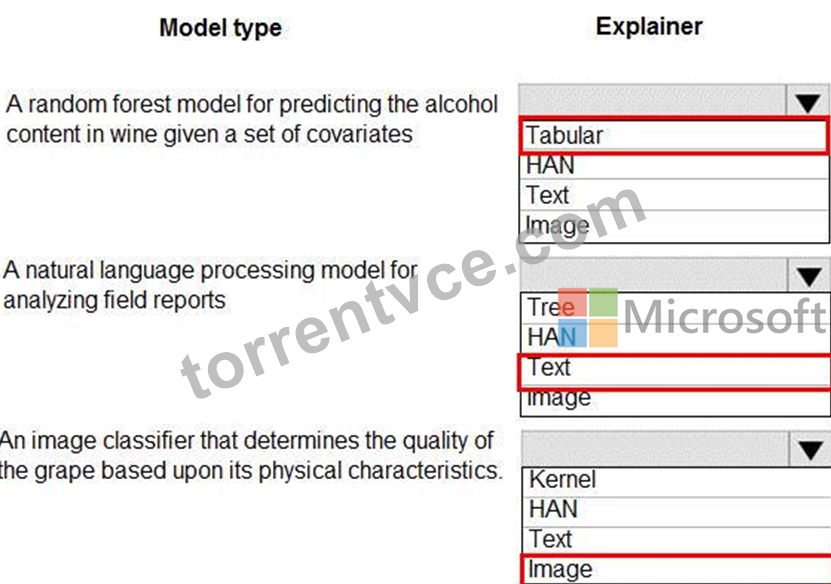
Reference:
https://medium.com/microsoftazure/automated-and-interpretable-machine-learning-d07975741298
NEW QUESTION # 237
You are performing a filter based feature selection for a dataset 10 build a multi class classifies by using Azure Machine Learning Studio.
The dataset contains categorical features that are highly correlated to the output label column.
You need to select the appropriate feature scoring statistical method to identify the key predictors. Which method should you use?
- A. Kendall correlation
- B. Spearman correlation
- C. Chi-squared
- D. Person correlation
Answer: D
Explanation:
Explanation
Pearson's correlation statistic, or Pearson's correlation coefficient, is also known in statistical models as the r value. For any two variables, it returns a value that indicates the strength of the correlation Pearson's correlation coefficient is the test statistics that measures the statistical relationship, or association, between two continuous variables. It is known as the best method of measuring the association between variables of interest because it is based on the method of covariance. It gives information about the magnitude of the association, or correlation, as well as the direction of the relationship.
Reference:
https://docs.microsoft.com/en-us/azure/machine-learning/studio-module-reference/filter-based-feature-selection
https://www.statisticssolutions.com/pearsons-correlation-coefficient/
Topic 1, Case Study 2
Case study
Overview
You are a data scientist for Fabrikam Residences, a company specializing in quality private and commercial property in the United States. Fabrikam Residences is considering expanding into Europe and has asked you to investigate prices for private residences in major European cities. You use Azure Machine Learning Studio to measure the median value of properties. You produce a regression model to predict property prices by using the Linear Regression and Bayesian Linear Regression modules.
Datasets
There are two datasets in CSV format that contain property details for two cities, London and Paris, with the following columns: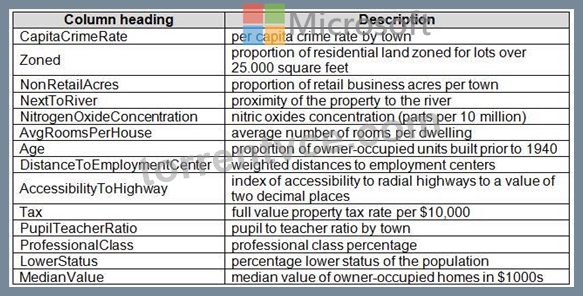
The two datasets have been added to Azure Machine Learning Studio as separate datasets and included as the starting point of the experiment.
Dataset issues
The AccessibilityToHighway column in both datasets contains missing values. The missing data must be replaced with new data so that it is modeled conditionally using the other variables in the data before filling in the missing values.
Columns in each dataset contain missing and null values. The dataset also contains many outliers. The Age column has a high proportion of outliers. You need to remove the rows that have outliers in the Age column.
The MedianValue and AvgRoomsinHouse columns both hold data in numeric format. You need to select a feature selection algorithm to analyze the relationship between the two columns in more detail.
Model fit
The model shows signs of overfitting. You need to produce a more refined regression model that reduces the overfitting.
Experiment requirements
You must set up the experiment to cross-validate the Linear Regression and Bayesian Linear Regression modules to evaluate performance.
In each case, the predictor of the dataset is the column named MedianValue. An initial investigation showed that the datasets are identical in structure apart from the MedianValue column. The smaller Paris dataset contains the MedianValue in text format, whereas the larger London dataset contains the MedianValue in numerical format. You must ensure that the datatype of the MedianValue column of the Paris dataset matches the structure of the London dataset.
You must prioritize the columns of data for predicting the outcome. You must use non-parameters statistics to measure the relationships.
You must use a feature selection algorithm to analyze the relationship between the MedianValue and AvgRoomsinHouse columns.
Model training
Given a trained model and a test dataset, you need to compute the permutation feature importance scores of feature variables. You need to set up the Permutation Feature Importance module to select the correct metric to investigate the model's accuracy and replicate the findings.
You want to configure hyperparameters in the model learning process to speed the learning phase by using hyperparameters. In addition, this configuration should cancel the lowest performing runs at each evaluation interval, thereby directing effort and resources towards models that are more likely to be successful.
You are concerned that the model might not efficiently use compute resources in hyperparameter tuning. You also are concerned that the model might prevent an increase in the overall tuning time. Therefore, you need to implement an early stopping criterion on models that provides savings without terminating promising jobs.
Testing
You must produce multiple partitions of a dataset based on sampling using the Partition and Sample module in Azure Machine Learning Studio. You must create three equal partitions for cross-validation. You must also configure the cross-validation process so that the rows in the test and training datasets are divided evenly by properties that are near each city's main river. The data that identifies that a property is near a river is held in the column named NextToRiver. You want to complete this task before the data goes through the sampling process.
When you train a Linear Regression module using a property dataset that shows data for property prices for a large city, you need to determine the best features to use in a model. You can choose standard metrics provided to measure performance before and after the feature importance process completes. You must ensure that the distribution of the features across multiple training models is consistent.
Data visualization
You need to provide the test results to the Fabrikam Residences team. You create data visualizations to aid in presenting the results.
You must produce a Receiver Operating Characteristic (ROC) curve to conduct a diagnostic test evaluation of the model. You need to select appropriate methods for producing the ROC curve in Azure Machine Learning Studio to compare the Two-Class Decision Forest and the Two-Class Decision Jungle modules with one another.
NEW QUESTION # 238
You monitor an Azure Machine Learning classification training experiment named train-classification on Azure Notebooks.
You must store a table named table as an artifact in Azure Machine Learning Studio during model training.
You need to collect and list the metrics by using MLfow.
how should you complete the code segment? To answer, select the appropriate option in the answer area.
NOTE: Each correct selection is worth on* point.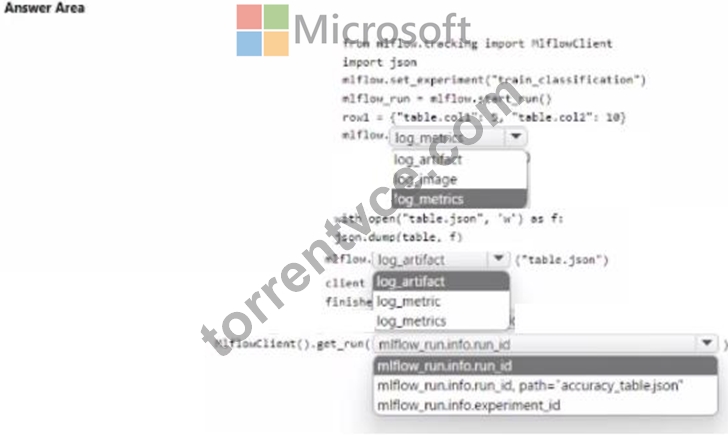
Answer:
Explanation: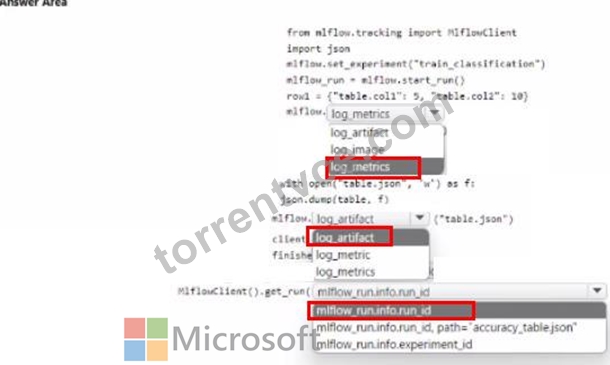
NEW QUESTION # 239
You have an Azure Machine Learning workspace. You are running an experiment on your local computer.
You need to ensure that you can use MLflow Tracking with Azure Machine Learning Python SDK v2 to store metrics and artifacts from your local experiment runs in the workspace.
In which order should you perform the actions? To answer, move all actions from the list of actions to the answer area and arrange them in the correct order.
Answer:
Explanation: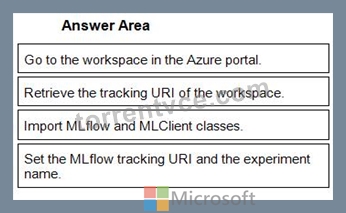
1 - Go to the workspace in the Azure portal.
2 - Retrieve the tracking URI of the workspace.
3 - Import MLflow and MLClient classes.
4 - Set the MLflow tracking URI and the experiment name.
NEW QUESTION # 240
You use Azure Machine Learning to train a model based on a dataset named dataset1.
You define a dataset monitor and create a dataset named dataset2 that contains new data.
You need to compare dataset1 and dataset2 by using the Azure Machine Learning SDK for Python.
Which method of the DataDriftDetector class should you use?
- A. get
- B. update
- C. backfill
- D. run
Answer: C
Explanation:
A backfill run is used to see how data changes over time.
Reference:
https://docs.microsoft.com/en-us/python/api/azureml-datadrift/azureml.datadrift.datadriftdetector.datadriftdetector
NEW QUESTION # 241
You use Data Science Virtual Machines (DSVMs) for Windows and Linux in Azure.
You need to access the DSVMs.
Which utilities should you use? To answer, select the appropriate options in the answer area.
NOTE: Each correct selection is worth one point.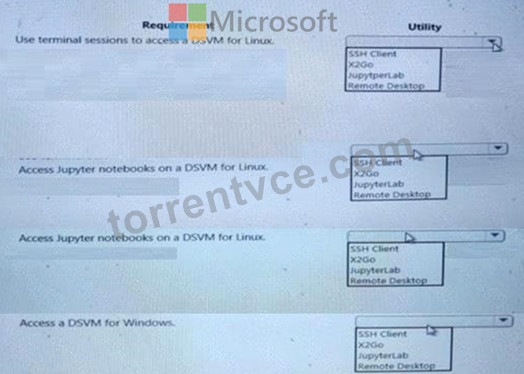
Answer:
Explanation: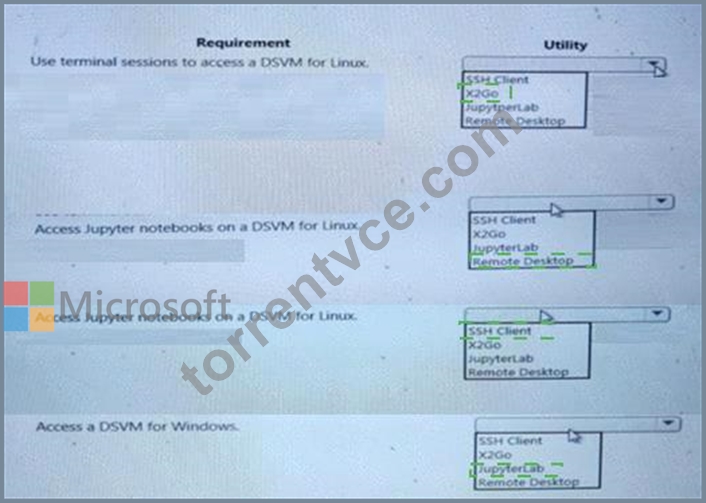
NEW QUESTION # 242
......
DP-100 Study Guide Cover to Cover as Literally: https://www.torrentvce.com/DP-100-valid-vce-collection.html
Get Unlimited Access to DP-100 Certification Exam Cert Guide: https://drive.google.com/open?id=1YTs_VwTtUlI1Bpr9h7stbEokt0HL4cKD