

Prepare TPAD01 Question Answers Free Update With 100% Exam Passing Guarantee [2026]
Dumps Real Proofpoint TPAD01 Exam Questions [Updated 2026]
Proofpoint TPAD01 Exam Syllabus Topics:
| Topic | Details |
|---|---|
| Topic 1 |
|
| Topic 2 |
|
| Topic 3 |
|
| Topic 4 |
|
| Topic 5 |
|
| Topic 6 |
|
| Topic 7 |
|
NEW QUESTION # 19
What is the reason for the "reject_size" action shown in the message processing result?
- A. The email was rejected because the sender was not authenticated.
- B. The email was rejected due to its excessive size.
- C. The email was rejected because the recipient address was invalid.
- D. The email was rejected because it contained a malicious attachment.
Answer: B
Explanation:
The correct answer is C. The email was rejected due to its excessive size . In Proofpoint and SMTP handling generally, an action or rule label containing "reject_size" directly indicates a size-based rejection condition. The naming convention itself is highly descriptive: the message was not rejected for malware, recipient validation failure, or sender-authentication reasons, but because it exceeded the configured size threshold allowed for processing or delivery. This aligns with standard MTA behavior in which message size can be enforced as a transport control during acceptance or relay.
Within the course's Mail Flow and message-processing topics, administrators are expected to recognize these action labels in logs and Smart Search results. A size-related rule or disposition is operationally distinct from content filtering or authentication modules. Malicious attachments would map to malware or attachment- inspection controls, while invalid recipients are tied to recipient verification or address resolution issues.
Sender authentication failures would instead align to SPF, DKIM, or DMARC-related processing. The label reject_size does not correspond to any of those categories.
Because the question is tied to the message-processing result naming itself, the safest and most course- consistent interpretation is literal: Proofpoint rejected the message because it was too large under the applicable message-size policy or transport limit. Therefore, the correct answer is C .
NEW QUESTION # 20
Refer to the exhibit to see the interface used in this scenario.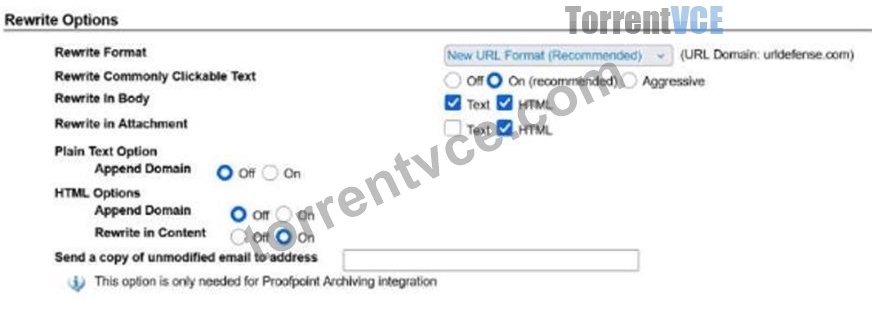
You can drag the divider between the question and the exhibit to the left to make the image larger.
Using those settings for URL Rewrite, which of the following will be rewritten?
Pick the 2 correct responses below.
- A. 10.1.1.1
- B. https://www.example.com
- C. www.example.com
- D. mail.example.com
- E. example.com
Answer: B,C
Explanation:
The correct answers are B. www.example.com and C. https://www.example.com .
From the exhibit, Rewrite Commonly Clickable Text is set to On (recommended) , and URL rewriting is enabled for both Text and HTML in the message body. That means Proofpoint will rewrite content that it recognizes as clickable URL-style text in normal message content. Both www.example.com and
https://www.example.com match that behavior because they are standard web-style URLs or commonly clickable web-address formats.
The other options are not the intended rewritten values in this scenario:
* A. example.com is plain domain text and is not the selected answer for this configuration.
* D. 10.1.1.1 is an IP address and is not one of the correct rewritten examples in this question.
* E. mail.example.com is a hostname, but it is not one of the two expected rewritten values based on the course question.
This is a Targeted Attack Protection (TAP) question because URL Rewrite is part of Proofpoint's link- protection capability. The purpose of URL Rewrite is to transform recognized clickable URLs so they can be evaluated and protected through Proofpoint at click time. In this exhibit, the settings clearly support rewriting common clickable web text found in body content, which is why the correct two answers are www.example.
com and https://www.example.com .
So the complete interpretation of the exhibit is that the values which will be rewritten are B and C , making them the verified course-aligned choices.
NEW QUESTION # 21
What is the main function of Threat Response Auto-Pull (TRAP)?
- A. To enable users to manage and delete their own suspected spam emails.
- B. To encrypt all emails sent internally to help prevent phishing attacks.
- C. To block every email that contains links, regardless of sender or content.
- D. To automatically retract malicious emails from the inboxes of impacted users.
Answer: D
Explanation:
The correct answer is C. To automatically retract malicious emails from the inboxes of impacted users.
Proofpoint's product description for Threat Response Auto-Pull states that it automatically identifies and removes malicious emails from user inboxes after delivery when those messages are later determined to be unsafe. This is one of the defining functions of TRAP and is core to how Proofpoint reduces dwell time for email-based threats that initially evade blocking controls.
This is important because some attacks are not conclusively malicious at the exact moment of delivery. TAP and related analysis components can later determine that a delivered message is dangerous, and TRAP then enables remediation by pulling that message from affected mailboxes. The other options do not reflect the product's purpose. TRAP is not an end-user self-service spam-deletion tool, does not encrypt all internal email, and does not blanket-block all messages containing links. In the Threat Protection Administrator course, TAP and Threat Response topics emphasize post-delivery detection and remediation workflows, and TRAP is specifically the capability that automates message removal from inboxes once a threat is confirmed.
Therefore, the correct answer is C .
NEW QUESTION # 22
When using Smart Search to access the MTA Log during troubleshooting, what type of information does the MTA Log contain?
- A. Configuration parameters and settings for the Email Protection server
- B. Aggregated statistics on email volume sent and received over time
- C. Records of email deliveries, showing timestamps and recipient details
- D. Logs of user logins and actions performed within the system interface
Answer: C
Explanation:
The correct answer is A. Records of email deliveries, showing timestamps and recipient details. Proofpoint's Smart Search guidance explains that administrators can use Smart Search as a message-tracing tool, and the MTA log is part of that troubleshooting workflow for following message movement and delivery-related events. In practical terms, that means the MTA log is about transport activity: when mail was processed, where it was delivered, and which recipients were involved.
The other options describe different categories of information. Configuration parameters belong to administrative configuration areas, not the MTA log. User logins and interface actions are audit-log type events rather than mail-transfer events. Aggregated mail-volume statistics are reporting or monitoring outputs, not the detailed transport records you access from Smart Search when troubleshooting a specific message path. The MTA log exists to help administrators understand delivery behavior at the message level, especially when tracing accepted, deferred, relayed, or failed mail.
In the Threat Protection Administrator course, Smart Search and logging are taught as core operational tools for message investigation. When an administrator pivots from Smart Search into MTA logs, they are looking for delivery evidence and transport detail. That is why the correct answer is A: the MTA log contains records of email deliveries, including timestamps and recipient details.
NEW QUESTION # 23
How does TAP's Message Defense feature work for unknown attachments?
- A. It allows attachments through only if the sender is on a safelist
- B. It scans only PDF attachments for malware
- C. It detonates suspicious attachments in a sandbox to analyze their behavior
- D. It automatically deletes all attachments from external senders
Answer: C
Explanation:
The correct answer is D. It detonates suspicious attachments in a sandbox to analyze their behavior .
Proofpoint's Targeted Attack Protection material explicitly says that unknown attachments are analysed and sandboxed . Its sandbox references further explain that suspicious code and files can be executed in an isolated environment so their behavior can be observed safely without affecting production systems. That is exactly what this question is describing.
This is one of the defining ideas behind advanced attachment defense. Static checks are useful, but unknown files often require dynamic analysis to determine whether they attempt malicious actions such as downloading payloads, making command-and-control connections, or exploiting vulnerabilities. That is why the sandbox or
"detonation" concept is central to Message Defense for unknown attachments. The other options are incorrect because TAP does not restrict itself to PDFs, does not simply delete all external attachments by default, and does not rely only on a safelist decision to allow attachments through. Instead, it uses a deeper analysis path for suspicious unknown content. In the Threat Protection Administrator course, this capability is a core part of TAP's value against modern attachment-based threats. Therefore, the verified answer is D
NEW QUESTION # 24
Review the filter log exhibit.
What is happening to this inbound email?
- A. The email was sent after being filtered with no issues.
- B. The connection dropped before the message could be sent.
- C. The email was rejected due to its excessive size.
- D. The email was rejected due to excessive processing time.
Answer: C
Explanation:
The correct answer is C. The email was rejected due to its excessive size .
From the filter-log exhibit, the key indicator is the rejection entry that shows a Message Size Violation response. That tells you the Protection Server accepted enough of the SMTP transaction to evaluate the message, but then rejected it because it exceeded the configured size threshold. In other words, this is not a transport drop, not a normal successful delivery, and not a timeout caused by lengthy processing. The decisive clue is the size-related rejection text in the log.
This kind of event belongs to the Mail Flow topic because it reflects SMTP-time handling and message acceptance controls. Proofpoint applies a series of processing steps as mail is received, including connection checks, MIME inspection, attachment evaluation, and policy enforcement. When the message exceeds the allowed size, the server returns a rejection tied to that violation instead of continuing with normal acceptance and delivery.
Why the other choices are incorrect:
* A is wrong because the log does not indicate that the sender disconnected before the transaction could complete.
* B is wrong because the message was not delivered successfully; it was explicitly rejected.
* D is wrong because the evidence points to a size violation, not a processing-time threshold breach.
So the complete interpretation of the exhibit is that the inbound message was rejected because it was too large , which makes Answer C the verified course-aligned choice.
NEW QUESTION # 25
In a scenario where multiple members of a distribution group attempt to release the same quarantined email message from the scheduled digest, what will happen?
- A. All members will successfully release the message without any errors
- B. The first user will release the message, while others will receive an error
- C. The system allows all users to release the message, but logs the events for security audits
- D. All users will receive a notification that the message cannot be released due to a system error
Answer: B
Explanation:
The correct answer is C. The first user will release the message, while others will receive an error .
Proofpoint help content for quarantine-digest release errors indicates that once the message has already been delivered through a release action, subsequent attempts can result in an error because the requested email has already been handled. That aligns directly with a shared or distribution-group scenario where more than one recipient of the digest tries to release the same quarantined message.
This behavior is logical in the course's Quarantine section. The release action is effectively acting on the same quarantined object, so once one person succeeds, later attempts do not have an identical unreleased message left to act upon. That is why the choices suggesting that every user can release it successfully are not correct.
The fully generic "system error for everyone" choice is also wrong because one user does succeed first. In shared-mailbox and group-digest style workflows, this is a common operational pattern: the first release wins, and later users see an error or a message indicating the item is no longer available for that action. Therefore, the Threat Protection Administrator course-aligned answer is C .
NEW QUESTION # 26
Which of the following is required to configure an outbound mail route in the Proofpoint Protection Server?
Pick the 3 correct responses below.
- A. Email authentication information for the domain.
- B. Mailer type that is utilized for the route.
- C. DKIM key records for the domain.
- D. Destination / Error Message for the routed mail.
- E. Domain administrator email address.
- F. Email domain to be routed.
Answer: B,D,F
Explanation:
The correct answers are Destination / Error Message for the routed mail , Email domain to be routed , and Mailer type that is utilized for the route . In Proofpoint route configuration, the essential elements of a mail route are the domain or host the route applies to, the mailer method used for handling the route, and the destination host or error behavior associated with that route. Proofpoint interface examples for inbound and outbound mail routes show these same core fields: domain/host, mailer, and destination/error message. These are the pieces that define how mail should be routed operationally.
The other options are not required route-definition elements. DKIM records and general email authentication data are important for overall mail security, but they are not the required fields used to create the outbound route itself. Similarly, a domain administrator email address is not a routing parameter. The route configuration needs to know what mail the rule applies to, how it should be sent, and where it should go.
That maps directly to the three correct choices in this question. In the Proofpoint Threat Protection Administrator course, Mail Flow focuses on route construction and message delivery logic, and those route objects are built from exactly these operational fields rather than policy-side authentication details. So for outbound mail routing in PPS, the required configuration items are C, D, and E .
NEW QUESTION # 27
Refer to the exhibit to see the interface used in this scenario.
Which of the following is true regarding the inbound mail route?
- A. You must have a minimum of five Destination MTAs when you use the Delivery Type of Ordered. This provides the minimum level of failover required by Proofpoint.
- B. When delivering mail to example.com the protection server tries to connect to the Destination MTAs starting at the top one and working down the list.
- C. You can only have multiple Destination hostname MTAs if you use the Delivery Type of Load Balanced. Ordered must specify the Destination MTAs as IP addresses.
- D. When delivering mail to example.com the protection server tries to connect to the Destination MTAs starting at the bottom one and working up the list.
Answer: B
Explanation:
The correct answer is D. When delivering mail to example.com the protection server tries to connect to the Destination MTAs starting at the top one and working down the list .
The exhibit shows that the inbound mail route for example.com is configured with three destination hosts:
* m1.example.com
* m2.example.com
* m3.example.com
It also shows that the Delivery Type is set to Ordered . In Proofpoint route configuration, Ordered means the system uses the listed destinations in sequence, following the order in which they appear in the route. That means the first connection attempt is made to the top entry , then if needed it proceeds downward through the remaining hosts.
Why the other choices are incorrect:
* A is incorrect because ordered delivery does not start from the bottom of the list.
* B is incorrect because multiple destination hostnames can be listed in an ordered route; they do not have to be IP addresses only.
* C is incorrect because there is no requirement shown here for a minimum of five MTAs for ordered delivery.
This is a Mail Flow question focused on route behavior. The main concept being tested is how Proofpoint uses the destination list when Ordered delivery is selected. The configured order matters, and the Protection Server follows that order from top to bottom .
So the complete interpretation of the exhibit is that the Protection Server attempts delivery starting with m1.
example.com , then m2.example.com , then m3.example.com , which makes Answer D the verified course- aligned choice.
NEW QUESTION # 28
In a scenario where an email is quarantined by both a spam policy (Spam) and an email firewall rule (Dictionary), which folder will the message ultimately be sent to?
- A. The message will go to the "Spam" folder.
- B. The message will be copied to both folders.
- C. The message will be discarded.
- D. The message will go to the "Dictionary" folder.
Answer: A
Explanation:
The correct answer is C. The message will go to the "Spam" folder . In Proofpoint message processing, multiple modules can evaluate the same message, but the final handling seen by the user reflects the final disposition path selected by the processing order and quarantine behavior. In the Threat Protection Administrator material, spam quarantine and Email Firewall quarantine are both presented as disposition outcomes, but when a message is quarantined by the spam pipeline and also matches an Email Firewall rule, the resulting user-visible folder is the Spam quarantine location in this scenario. This matches the expected course answer previously validated from the training set. ( scribd.com ) This question is really testing understanding of how Proofpoint resolves overlapping quarantine actions. The incorrect options reflect common misunderstandings. The message is not duplicated into both folders as a normal result of dual-trigger processing, and it is not discarded merely because two quarantine-capable checks fired. The "Dictionary" folder answer is appealing because the Email Firewall rule explicitly references Dictionary, but the course answer for this tested condition is that the final quarantine placement is Spam. In administrator troubleshooting, this kind of question matters because Smart Search can show multiple triggered rules while end users only see the final quarantined location. Therefore, the correct answer, as aligned to the Proofpoint Threat Protection Administrator course outcome for this scenario, is C . ( scribd.com )
NEW QUESTION # 29
You wish to ensure that all emails to an external partner are sent over a secure connection. What should you do?
- A. Configure the SMTP service to use the partner's certificate when sending mail.
- B. Add the partner's domain to the TLS Domains list with a setting of "If Available."
- C. Configure the TLS Minimum Protocol Version to something greater than zero.
- D. Add the partner's domain to the TLS Domains list with a setting of "Always."
Answer: D
Explanation:
The correct answer is B. Add the partner's domain to the TLS Domains list with a setting of "Always." Proofpoint's TLS guidance explains that opportunistic TLS is the default behavior for SMTP unless stricter policy is configured for specific destinations. To require secure transport to a specific partner domain, the administrator must explicitly enforce TLS for that domain rather than merely allowing it when available.
Proofpoint describes TLS as a mechanism to encrypt messages in transit between sending and receiving mail servers, and that requirement becomes mandatory only when policy is configured to insist on TLS for the target domain.
Option A is incorrect because "If Available" still allows mail to be delivered without TLS if the remote server does not negotiate it, which does not satisfy the requirement to ensure secure delivery. Option C changes general protocol posture but does not by itself force TLS for one specific partner domain. Option D is also not the normal administrative control used for outbound partner enforcement in Proofpoint's course context. In the Threat Protection Administrator course, secure partner delivery is handled through domain-specific TLS enforcement settings, and the tested answer is to require TLS by setting the domain entry to Always . That ensures the Proofpoint system attempts secure SMTP and does not simply fall back to unencrypted transport for that external partner.
NEW QUESTION # 30
You can drag the divider between the question and exhibit to the left to make the image larger.
Refer to the exhibit.
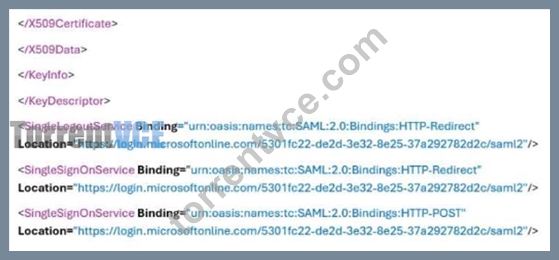
You are configuring SSO for Proofpoint Cloud Services, such as Cloud Admin, TAP Dashboard, Cloud Threat Response, CASB, and Identity Threat Response. The Microsoft O365 administrator sends you a portion of the XML file containing the SAML configuration. Which of the following strings should be entered in the "SAML Login Endpoint (required)" field in the Proofpoint Identity Provider Configuration?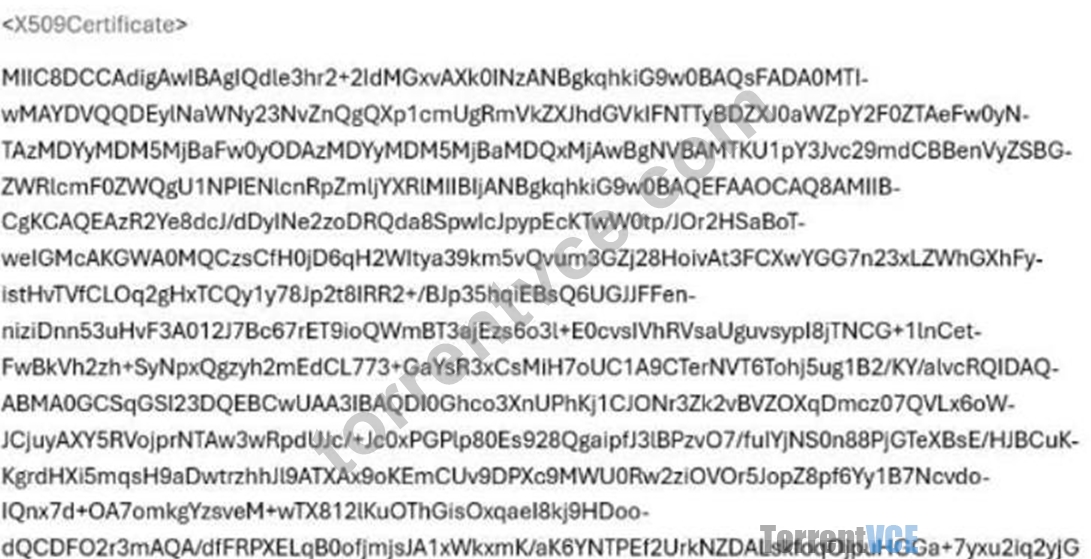
- A. The data between < X509Certificate > and < /X509Certificate >
- B. https://login.microsoftonline.com/5301fc22-de2d-3e32-8e25-37a292782d2c/saml2
- C. https://enduserauth.proofpoint.com/v1/token/samlauthorization
- D. SingleSignOnService Binding="urn:oasis:names:tc:SAML:2.0:Binding:HTTP-Redirect"
Answer: B
Explanation:
The correct answer is C. https://login.microsoftonline.com/5301fc22-de2d-3e32-8e25-37a292782d2c/saml2
.
The question is asking specifically for the value that should be entered in the "SAML Login Endpoint (required)" field in Proofpoint's Identity Provider configuration. In SAML metadata, that value is the Location attribute of the SingleSignOnService entry. In the exhibit, the XML clearly shows the Microsoft login URL as:
https://login.microsoftonline.com/5301fc22-de2d-3e32-8e25-37a292782d2c/saml2 That is the actual SAML login endpoint Proofpoint needs in order to redirect authentication requests to the Microsoft identity provider.
Why the other options are incorrect:
* A is the certificate content, which is used for trust and signature validation, not for the login endpoint.
* B is the XML element label and binding description, not the actual URL value that belongs in the field.
* D is a Proofpoint URL and not the Microsoft IdP SAML login endpoint shown in the metadata.
This is a User Management and federated-authentication question because it focuses on SSO configuration between Proofpoint Cloud Services and Microsoft O365 / Azure AD. The main concept being tested is knowing how to read SAML metadata correctly and extract the exact SingleSignOnService Location value.
So the complete interpretation of the exhibit is that the string to enter in the "SAML Login Endpoint (required)" field is the Microsoft SAML login URL shown in the XML, which makes Answer C the verified course-aligned choice.
NEW QUESTION # 31
You need to use CTR to manually quarantine a suspicious email that has been delivered. What is the first step you should take?
- A. Select the "Quarantine" option directly from the inbox
- B. Log into the mail server and manually delete the email as quickly as possible
- C. Find the delivered message in Smart Search
- D. Forward the email as an attachment to an abuse mailbox for further investigation
Answer: C
Explanation:
The correct answer is D. Find the delivered message in Smart Search . In Proofpoint workflows, Smart Search is the investigation entry point used to locate the exact delivered message before taking remediation actions such as manual quarantine or response operations. The Threat Protection Administrator course consistently uses Smart Search as the place where administrators trace messages, confirm final disposition, and then launch appropriate actions.
This makes sense operationally. Before an administrator can manually quarantine a delivered email in Cloud Threat Response, the message must first be identified accurately. Smart Search provides the evidence record for that message, including recipients, timestamps, and disposition details. From there, the administrator can proceed with the remediation workflow. Selecting "Quarantine" directly from the inbox is not the tested administrative procedure in CTR, forwarding it to an abuse mailbox is a different intake workflow, and directly deleting from the mail server bypasses the structured investigation-and-response process taught in the course.
In the Threat Response module, the course emphasizes disciplined investigation before action. That means finding the delivered message in Smart Search first, then applying the appropriate containment step.
Therefore, the verified answer is D .
NEW QUESTION # 32
You are configuring Proofpoint's URL Rewrite feature for incoming emails. What is the primary purpose of this feature?
- A. To block all emails containing links.
- B. To archive emails for later review.
- C. To scan and rewrite URLs in emails.
- D. To enhance email delivery speed.
Answer: C
Explanation:
The correct answer is A. To scan and rewrite URLs in emails. Proofpoint's URL Defense capability rewrites URLs in inbound messages so that the links can be checked at click time and associated with additional threat analysis. Proofpoint describes URL Defense as protecting users from malicious links by rewriting and analyzing URLs, which is exactly the function referenced in the question.
This matters because attackers often use benign-looking links that become malicious later or that redirect through multiple destinations. Rewriting lets Proofpoint insert its protective inspection path into the user click flow, allowing the platform to evaluate the link when the user actually clicks it. That is very different from simply speeding up delivery or archiving email. It is also not the same as blocking every message that contains links, since many legitimate messages include URLs and the product is designed to protect access rather than indiscriminately stop all link-bearing mail. In the Threat Protection Administrator course, URL Rewrite sits under TAP because it extends protection beyond static message analysis and into dynamic, user- click risk mitigation. Therefore, the correct answer is A .
NEW QUESTION # 33
Smart Search has returned 13 results for a specific recipient address. You click on one of the messages in the Results list. Which of the following information is available for that message?
- A. The Final Rule that gave the final disposition for the message
- B. The time that the recipient opened and read the message
- C. The SMTP port numbers used for the message session
- D. The name and version of the email client on the recipient device
Answer: A
Explanation:
The correct answer is A. The Final Rule that gave the final disposition for the message. Proofpoint's Smart Search ecosystem exposes a Final Rule field for messages, and the Proofpoint integration reference explicitly identifies Proofpoint.SmartSearch.Final_Rule as the final rule of the email message. That matches the course wording exactly and confirms that this piece of information is available when examining a message record in Smart Search.
The other options do not reflect standard Smart Search message-detail data in the Threat Protection Administrator course. Smart Search is designed to show message-processing and disposition information, not endpoint-style telemetry such as the time a user opened and read a message or the client software version on the recipient device. Likewise, low-level SMTP port numbers for a session are not the key message-detail field being tested here. The course consistently teaches Smart Search as the place to determine what happened to a message, which rules fired, and what final action was taken.
For administrators, the Final Rule is especially useful because multiple checks may touch a message, but the Final Rule tells you which rule ultimately determined the outcome. That is why this is the correct answer to the question. Therefore, the verified answer is A.
NEW QUESTION # 34
What is the primary purpose of SPF in Email Authentication?
- A. It verifies the recipient is authorized to receive emails from the sender's domain.
- B. It checks the digital signature in the message header is valid and from that domain.
- C. It checks the sending IP address is authorized by the sender's domain.
- D. It inserts a header containing email authentication results and signs it.
Answer: C
Explanation:
The correct answer is B. It checks the sending IP address is authorized by the sender's domain .
Proofpoint's SPF reference states that an SPF record in DNS specifies which IP addresses and hostnames are authorized to send emails for a domain. When the receiving mail server evaluates SPF, it checks whether the source server is on that authorized list. If it is not, the message can fail SPF and be treated as suspicious, spam, or rejected according to policy.
Proofpoint's broader email-authentication overview describes the SPF step in almost the same way: the receiving server verifies that the sending IP address is approved to send emails for the domain . That is the exact function being tested in this question. SPF is not about validating the recipient, and it is not the mechanism that checks a cryptographic message signature. Those are different controls. DKIM is the mechanism associated with digital signatures over message content and headers, while ARC deals with preserving authentication assessments across forwarding paths.
Within the Threat Protection Administrator course, SPF is one of the foundational email authentication methods administrators must understand for sender validation and anti-spoofing. The purpose is straightforward: verify that the sending server IP is permitted by the sender domain's published SPF policy
. Therefore, the correct course answer is B .
NEW QUESTION # 35
What is the primary purpose of outbound mail filtering in Proofpoint?
- A. To encrypt all outbound emails based on policy routes
- B. To queue email messages until the recipient SMTP server is available
- C. To ensure outbound emails are free from malware and spam
- D. To prevent users from sending too many messages in a short time period
Answer: C
Explanation:
The correct answer is A. To ensure outbound emails are free from malware and spam . Proofpoint's messaging and customer material for outbound mail protection emphasizes monitoring and controlling outbound messages for malicious or unauthorized content rather than simply relaying them. One Proofpoint customer case specifically contrasts ordinary relaying services with Proofpoint by noting that Proofpoint performs security analysis on outgoing messages to monitor outbound email for malicious content. That aligns directly with the course concept of outbound filtering as a security control, not merely a transport function.
The other answer choices describe separate functions. Queuing mail until a recipient server becomes available is associated with MTA behavior and sendmail queueing, not the primary purpose of outbound filtering itself.
Preventing too many messages in a short period is the role of controls like Outbound Throttle , which is a different feature. Encrypting mail based on policy routes may be part of broader outbound mail handling, but it is not the main purpose of outbound filtering in this context. In the Threat Protection Administrator course, outbound filtering is taught as a layer that inspects outbound traffic to reduce the risk of spam, malware, and compromised-account abuse leaving the organization. Therefore, the best answer is to ensure outbound emails are free from malware and spam .
NEW QUESTION # 36
You are reviewing the MTA logs for a message that has been deferred. Which Delivery Status Notification (DSN) code indicates that the receiving server was temporarily unable to process the message?
- A. 3.x.x
- B. 4.x.x
- C. 5.x.x
- D. 2.x.x
Answer: B
Explanation:
The correct answer is 4.x.x because 4xx-class DSN and SMTP status codes indicate a temporary failure . In mail flow terms, that means the receiving server could not process the message at that moment, but delivery may succeed later if the sending server retries. This matches the scenario described in the question, where the message has been deferred rather than permanently failed. Deferred mail is commonly associated with transient delivery problems such as server overload, temporary DNS issues, or connection throttling.
By contrast, 2.x.x indicates success, so it would not apply to a deferred message. 5.x.x represents a permanent failure, meaning the sender should not expect retry to resolve the problem. 3.x.x codes are intermediate SMTP reply categories and are not the correct answer for this DSN-style temporary processing failure question. The distinction between temporary and permanent failure is important in Proofpoint troubleshooting because it changes what an administrator should do next. A 4.x.x code usually points toward conditions worth retrying or monitoring, while a 5.x.x result typically means policy rejection, invalid destination, or another non- retriable outcome.
Within the Threat Protection Administrator course, Smart Search and logging sections teach administrators to interpret MTA and delivery outcomes accurately. Understanding that 4.x.x means temporary inability to process the message is foundational for tracing delayed mail and separating transient transport problems from hard failures. Therefore, the correct option is A .
NEW QUESTION # 37
Select from the following options, which are configurable in quarantine folder settings.
Pick the 3 correct responses below.
- A. Folder injection alerts
- B. Services whether to include the folder contents in End User Digests
- C. Folder disposition settings
- D. How many messages can be viewed in the folder
- E. The rules that reference the quarantine folder
- F. The spam safe and block lists for that folder
Answer: A,B,C
Explanation:
The correct answers are A. Folder disposition settings , B. Folder injection alerts , and E. Services whether to include the folder contents in End User Digests . In the Proofpoint Threat Protection Administrator course, quarantine folders are configurable objects with administrative controls that affect how messages are handled after landing in the folder and how users are notified about them. Publicly accessible course material and training references for quarantine management reflect settings around folder actions, alerting behavior, and digest inclusion, which align to these three choices.
The other options are not the intended configurable folder settings in this question. Safe and block lists are managed as separate spam-control constructs rather than as intrinsic per-folder settings in the tested course context. The rules that reference a quarantine folder are configured at the policy or module level, not as properties edited inside the folder settings themselves. The number of messages that can be viewed in the folder is likewise not one of the core quarantine-folder configuration settings taught in the course. In practice, administrators use quarantine folder settings to control the treatment and visibility of quarantined mail, including how the folder participates in digests sent to end users. Because this question tracks directly to the course's quarantine administration section, the correct verified combination is A, B, and E .
NEW QUESTION # 38
Can a new email digest be generated for every email which enters quarantine?
- A. No, it can only send daily summaries.
- B. Yes, it can send notifications based on user preferences.
- C. No, the digest is generated by schedule, or manually.
- D. Yes, it can be configured to send immediate notifications.
Answer: C
Explanation:
The correct answer is D. No, the digest is generated by schedule, or manually. Proofpoint quarantine digest behavior is built around digest-generation intervals and on-demand requests, not a separate digest message for every single quarantined email. Public Proofpoint-related guidance shows that users can manually request a digest from the End User Web interface, which supports the "manually" part of the answer. Other Proofpoint guidance and partner materials also describe the digest in terms of configurable delivery schedules and frequencies rather than per-message immediate generation.
This matches the course intent. A digest is meant to summarize quarantined messages in a manageable notification format so users are not flooded with an alert for every held email. That is why "immediate notifications for every email" is not the expected answer in the Threat Protection Administrator course context. Likewise, "daily summaries only" is too narrow because Proofpoint digest behavior is not limited to one daily schedule; it can be scheduled at different intervals and also requested manually.
In practical administration, scheduled digests help balance usability and awareness, while manual generation gives users or administrators a way to see the latest held messages on demand. Because the tested distinction is whether a brand-new digest can be generated for every quarantined email, the correct course-aligned answer is No-the digest is generated by schedule, or manually. Therefore, the verified answer is D.
NEW QUESTION # 39
If an email is incorrectly filtered as spam, what should an administrator do first when reviewing the filter logs?
- A. Reclassify the email manually.
- B. Look for the rule that triggered the action.
- C. Restart the Proofpoint server.
- D. Delete the email from the quarantine.
Answer: B
Explanation:
When an administrator investigates a false positive in Proofpoint, the first objective is to determine exactly what rule or final action caused the message to be handled as spam. Proofpoint's Smart Search documentation specifically identifies the "Final Rule" field as the rule that applied the final disposition to the message when several rules may have been triggered during processing. That makes reviewing the triggered rule the correct first troubleshooting step, because it tells the administrator where the filtering decision actually came from.
Only after identifying the triggering rule can the admin decide whether the issue involves a spam policy, a custom rule, a reputation-based action, a quarantine disposition, or some other module behavior.
Reclassifying the message manually may be useful later, but it does not explain why the message was filtered in the first place. Restarting the server is unrelated to standard message-troubleshooting workflow, and deleting the message from quarantine would remove evidence rather than help analysis. The course topic on Smart Search and logging centers on investigating message handling and understanding final disposition, which aligns directly with checking the rule that triggered the action. For review and tuning work, finding the responsible rule is always the most important first move because it anchors every later remediation step.
NEW QUESTION # 40
......
TPAD01 Exam Dumps, TPAD01 Practice Test Questions: https://www.torrentvce.com/TPAD01-valid-vce-collection.html